Categories
cobbwebs-news-and-views

Ipswich Minster

As I write, this very day (19th January 2025), St. Mary le Tower, the civic church of Ipswich is being redesignated IPSWICH MINSTER.  Described as a rare and historic honour, the Reverend Tom Mumford said that the new designation recognises the church in Tower Street has been at the heart of Ipswich for more than 1000 years.

In 1200 the churchyard of St. Mary le Tower was the site of the granting of a charter by which Ipswich came into being.  The churchyard is also the site of a poignant memorial to the martyred Bishop of Melanesia, John Coleridge (Coley) Patteson (1827-1871) #2465 on the web family tree. (For a fuller account click here or see the book Cobbold & Kin, page 43).

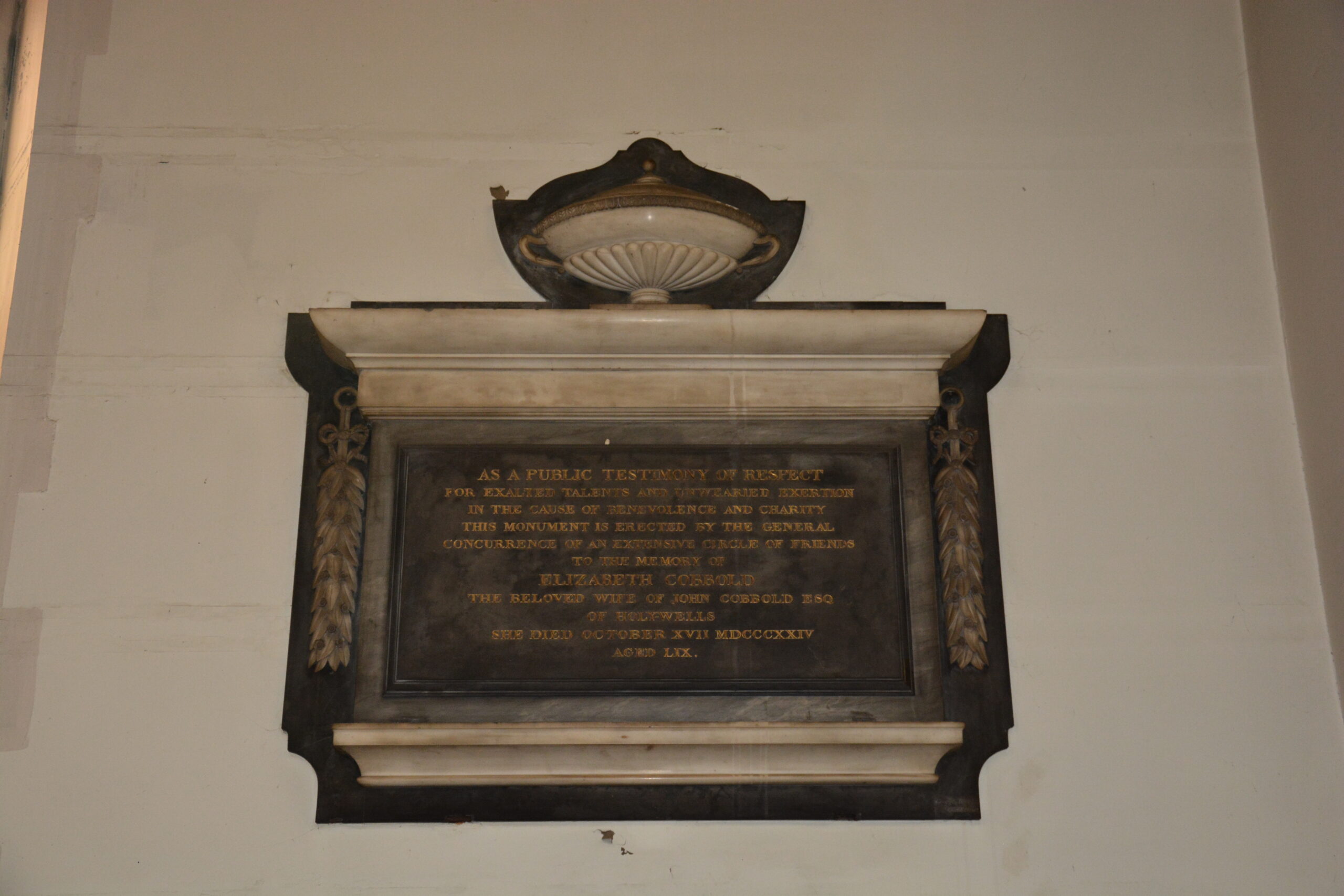
Grade II listed with a spire reaching 60 metres into the sky, St. Mary le Tower, one of 12 medieval churches surviving in Ipswich to this day has always been at the centre of Ipswich civic life.  It has also been significant in the life of the Cobbold family.  The Reverend Thomas Cobbold (1742-1831) #51 was vicar for 53 years and was succeeded by Reverend Francis Cobbold (1803-1844) #121 who served another 7 years.  Thomas, his wife, Anne, his eldest son, also Thomas who died at Trinity College, Cambridge, aged 20 and another son, Robert Chevallier who died in infancy are all commemorated on a plaque high on the north wall.

Other Cobbold memorials in St. Mary le Tower include:

John Chevallier Cobbold (1797-1882) #114

John Patteson Cobbold (1831-1875) #186

Lucy Cobbold (1828-1916) #182

Sarah Cobbold (1779-1841) #75

Mary Ann Fernley Cobbold (1776-1857) #73

Nathanael Fromanteel Cobbold (1839-1886) #195

Thomas Clement Cobbold (1833-1883) #191

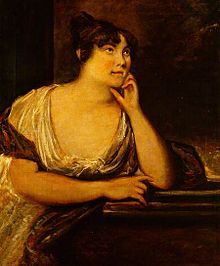
Perhaps, most important of all is the plaque commemorating Elizabeth Cobbold née Knipe (1765-1824) #56, mother of Richard Cobbold (1797-1877) #106.  Extraordinarily the St. Mary le Tower website claims that Richard Cobbold is buried there.  The Trust is very familiar with his grave in Wortham where he rests in peace with his wife.  Curiously, he and his wife died within 5 days of each other but in different years!

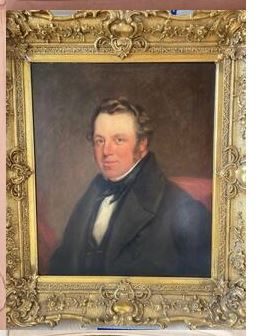
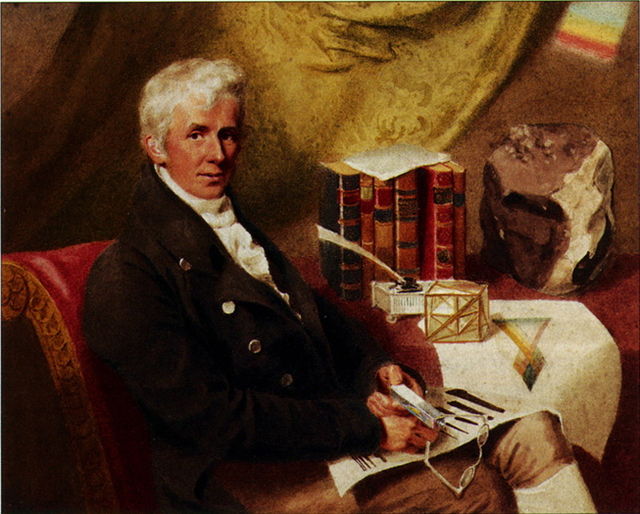
The Trust is truly grateful for a portrait of Richard Cobbold, donated recently by Juliet Felton #13674.

Anthony Cobbold

Categories
cobbwebs-news-and-views

Christmas 2024

I have observed, contrary to expectations, no reduction in the number of Christmas cards dropping on my door mat.  I looked at them several times and enjoyed them all but four particularly caught my attention:

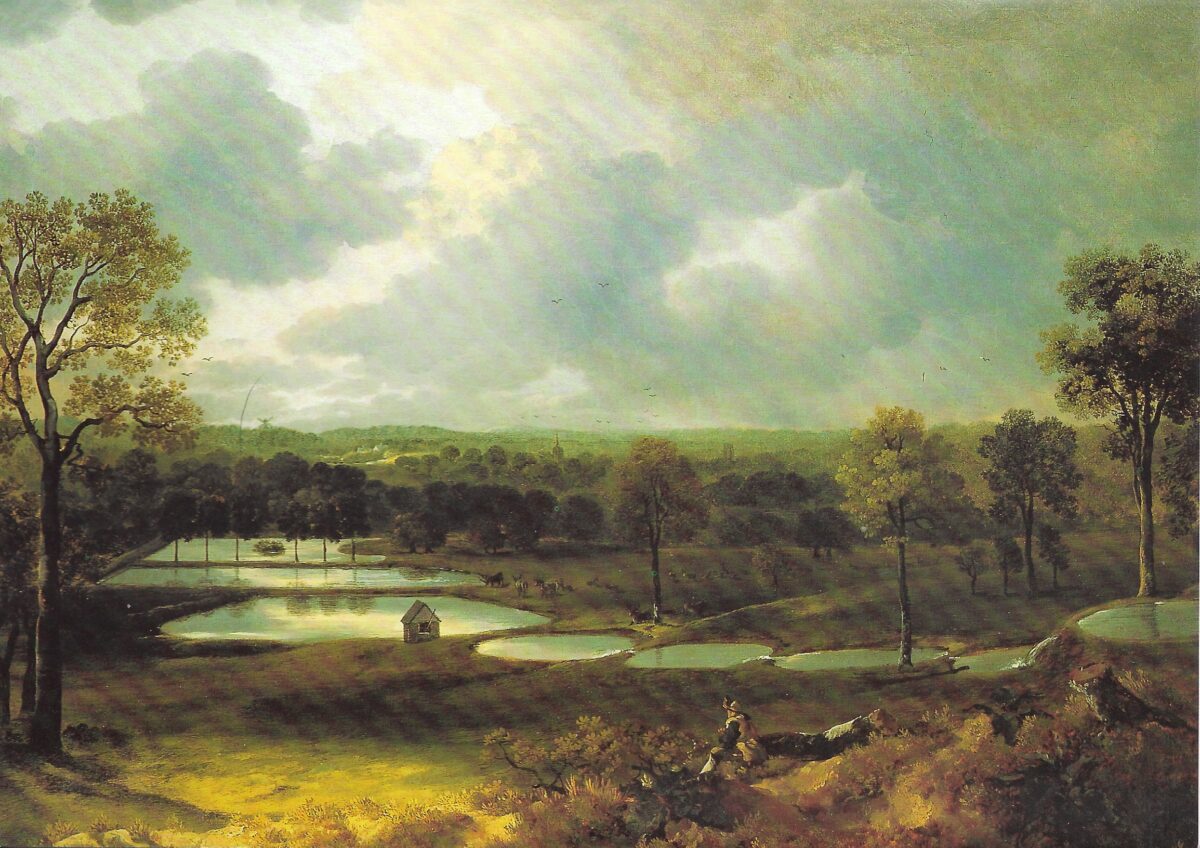
Most famous: Holywells Park, Ipswich, 1748-50, Thomas Gainsborough, a panoramic view looking north-east showing the series of man-made pools constructed by Thomas Cobbold from natural springs to provide pure water for his brewery.  Sold in aid of Ipswich Borough Council.

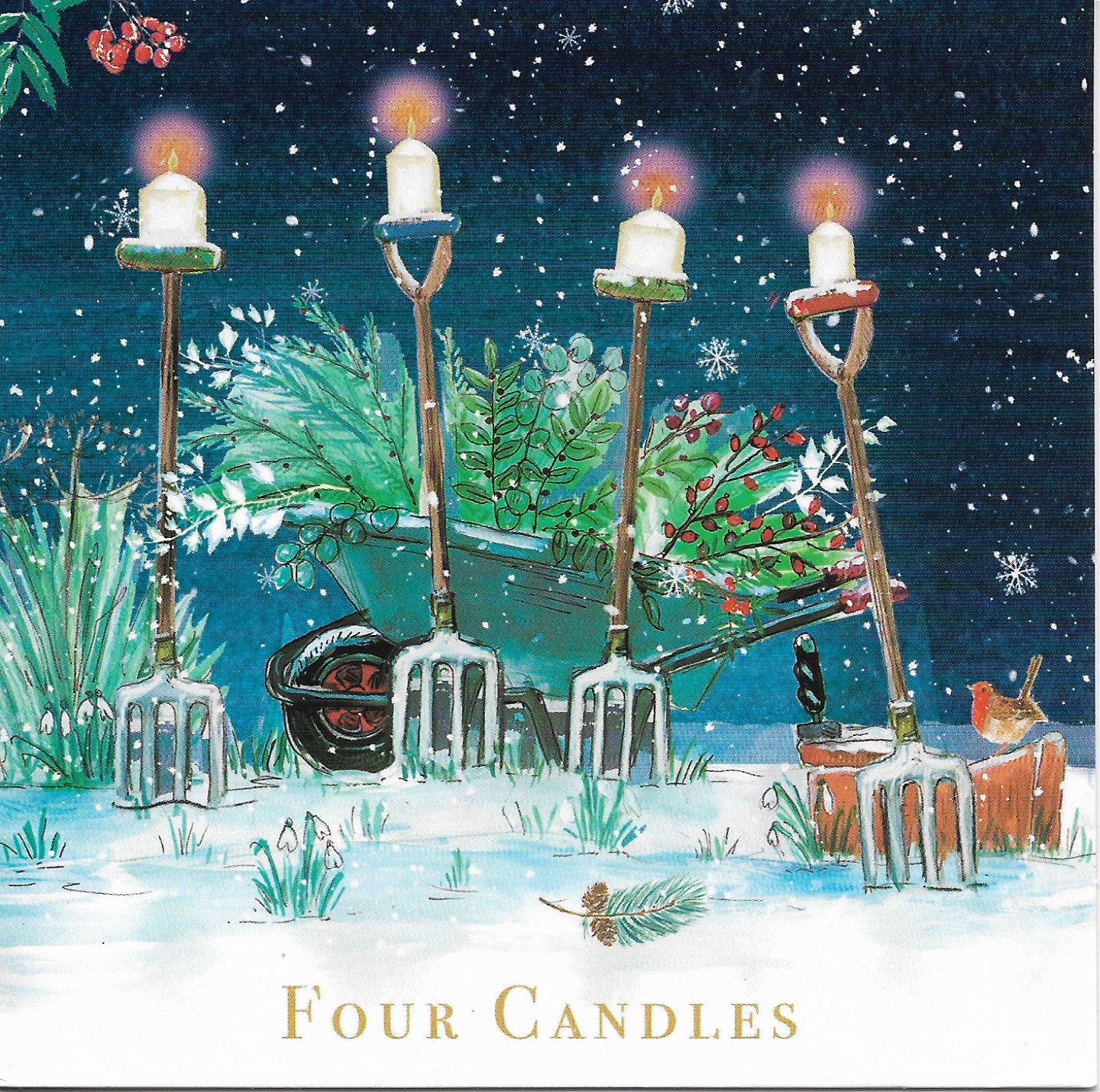
Most humorous: Four Candles, from the BBC comedy show, The Two Ronnies first shown 18th September 1976 in which a shopkeeper (Ronnie Corbett) becomes increasingly frustrated by a customer (Ronnie Barker) because he misunderstands what is being requested.  Sold in aid of RSPB.

Most unusual: Sledging on Hampstead Heath, 1925, native American Sioux chiefs take a break from the Christmas extravaganza at Olympia.  Sold in aid of Research to Prevent Blindness, being undertaken by St. Thomas’ & Guy’s Hospitals.

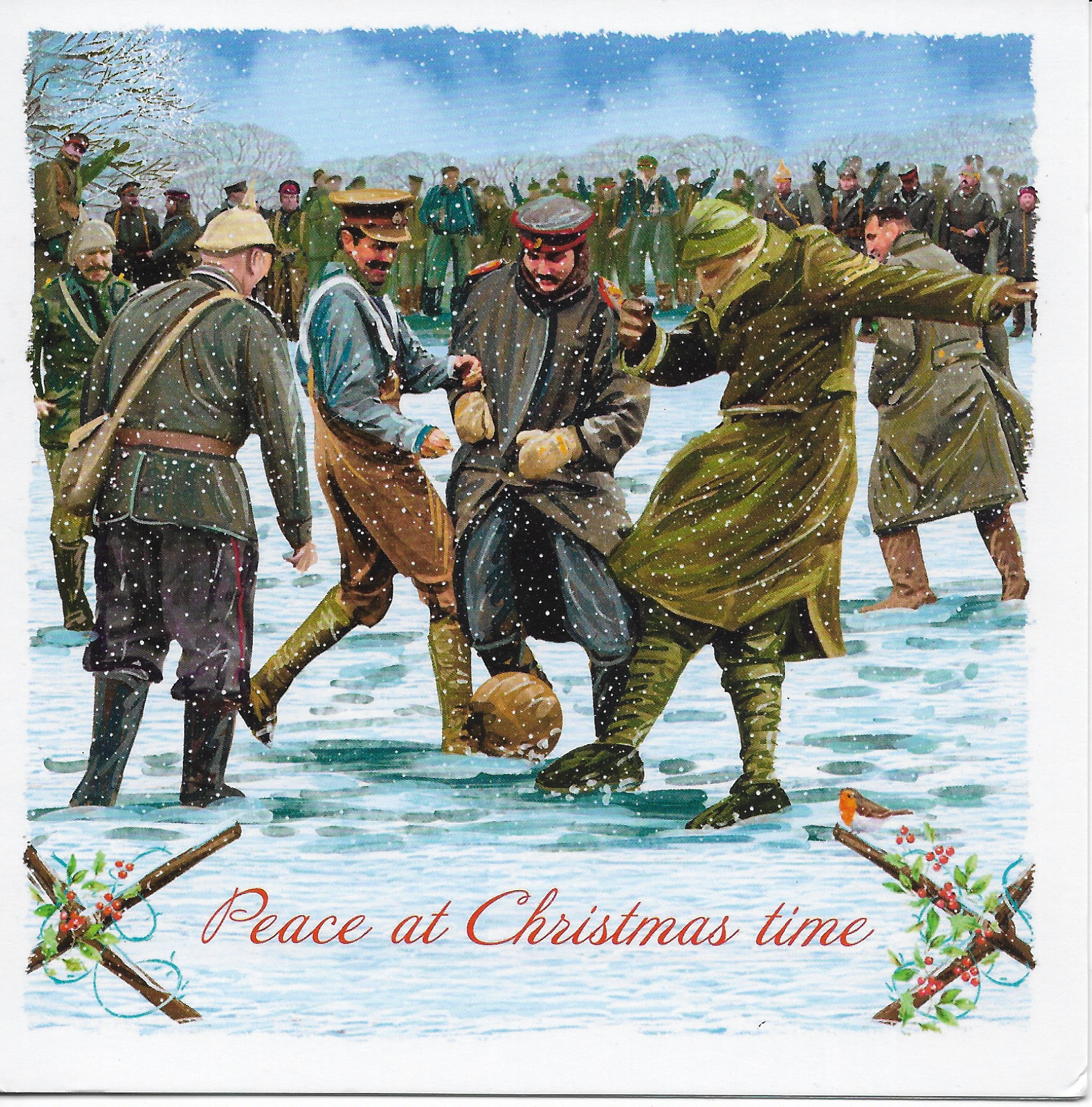
Most poignant: No Mans Land Football; late on Christmas Eve 1914 men of the British Expeditionary Force heard German troops in trenches opposite singing carols.  Greetings were exchanged between trenches.  The following day British and German soldiers met in No Mans Land, exchanged gifts, took photographs and played impromptu football.  Sold in aid of Combat Stress, UK’s leading charity for veterans’ mental health.

The best greeting:  Eat, drink and be merry, for tomorrow we….diet!

Anthony Cobbold

Categories
status_update

Happy New Year!

Everyone at the Cobbold Family History Trust would like to wish all family members and friends a peaceful, prosperous and joyful 2025.

Categories
status_update

Season’s Greetings!

The Trustees, Keeper and everyone connected with the Cobbold Family History Trust would like to pass on their best wishes to all our website visitors. If you would like to be added to our email mailing list, please send Katherine a message: cobboldtrust@knebworthhouse.com.

The archive will be closed from 2:50pm on Tuesday 17th December, re-opening on Tuesday 7th January 2025.

Categories
cobbwebs-news-and-views

Elizabeth Knipe Cobbold

On a mild, cloudy, but fortunately dry, day last week, 30th November 2024, a small assembly outside the stable block at Holywells witnessed the unveiling of an Ipswich Society blue plaque to Elizabeth Cobbold, second wife of ‘Big’ John Cobbold (1745-1835) #56 on the web family tree.

We have understood for a long time that Elizabeth (née Knipe) was ahead of her time in a variety of interests, one of them being Geology.  Her findings have been of interest to Geo Suffolk for some time and are recorded by Caroline and Robert Markham in Suffolk Biodiversity Information Service’s journal volume 56 (2020) from which we have abridged the following:

Elizabeth Cobbold of Ipswich collected and identified fossils from Suffolk Crag deposits (for the most part from what is now known as Red Crag) in the early nineteenth century.  Her specimens were first published by James Sowerby of London in his Mineral Conchology from 1813.  This is more than 200 years ago, 8 years before the first paper on Mary Anning’s specimens was published by the Geological Society of London and 46 years before Charles Darwin’s ‘On the Origin of Species’ was published – she was a contemporary of pioneering palaeontologists Gideon Mantel and Georges Cuvier.  Such early scientific endeavour deserves to be recorded and celebrated.

She was introduced to James Edward Smith of Norwich, a founder and first president of the Linnaean Society (in London in 1788) by Nicholas Gwyn (1710-1798) an Ipswich botanist in August 1793.  James Smith arranged for ‘Mrs. Cobbold’ (as she would be known in scientific circles) to receive the first part of ‘Flora Anglica.’  This was a new publication by James Smith and the natural history artist and publisher James Sowerby of Lambeth, London.  Elizabeth Cobbold contributed records to the ‘Flora’ including the ‘weeds’ summer snowflake and meadow-saffron at Little Stonham.  In 1810 (17th April) Elizabeth Cobbold’s paper on ‘On the Fasciola Hepatica’ (concerning liver fluke) was read (but not by her as women were not allowed) to the Linnaean Society.

About half a century later her grandson, Dr Thomas Spencer Cobbold (1828-1886) #174, helminthologist and parasitologist became a member and frequent contributor to the Linnaean Society.  He knew all about his grandmother’s early pioneering endeavours; perhaps some of her scientific genes survived?

Anthony Cobbold

Categories
cobbwebs-news-and-views

A Reminder of ‘White Mischief’ 

The Trust was saddened to read recently of the death of Sir Henry Neville Lindley Keswick (1938 – 2024) #991 on the web family tree, and we send our warmest condolences to his family.

Sir Henry’s wife Tessa (1942-2022) #999 was the daughter of Brigadier Simon Christopher Joseph Fraser DSO MC TD, 15th Baron Lovat (1911-1995) #2342 and Rosamond (Rosie) Delves Broughton (1917-2012).

The Brigadier was the 25th Chief of the Clan Fraser and was a decorated Marine Commander on Sword Beach for the WWII D-Day landings.  His heroic story and that of his clan piper Bill Millin is told in his biography – HERE.  But what we have not written about previously is Rosie’s relationship to the hedonistic Happy Valley set in Kenya in the 1940s.

Rosie’s father was Sir Henry John (Jock) Delves Broughton DL (1883-1942) #15202 the 11th Baronet who achieved some unwanted fame by standing trial for the murder of the 22nd Earl of Erroll.  The Happy Valley set was an exclusive, tightly knit, and promiscuous circle in colonial Kenya behaving as an antidote to wartime Britain.  Jock, born at Doddington Hall in Cheshire was a young Army officer when he married Vera Edyth Griffith-Boscawen (1894-1968) #15203 in 1913.  He is said to have sold off thousands of acres of family lands to pay off gambling debts which may have contributed to his divorce.  In 1940 he married a second time, Diana Caldwell and together they moved to Kenya.

Lord Erroll was found dead, shot in the head, in his car on the outskirts of Nairobi in January 1941.  Because Diana had been very publicly carrying on an affair with Lord Erroll, Jock became a suspect but was acquitted for lack of evidence.  The case hung on the fact that Jock’s pistol had 6 grooves but Erroll had been killed by a pistol with only 5 grooves.  The set seems to have thought him guilty as he was ostracised and it may have been right as he ended his life by committing suicide in the Adelphi hotel in Liverpool.

Unsurprisingly, there have been a plethora of ‘suspects’ the most popular being Diana Caldwell but none have come to trial.  An unsolved murder is irresistible to authors and film makers and this one was no exception. White Mischief by James Fox was published in 1982 and was followed by a film of the same name in 1987.  Stories of a long-gone world!

Anthony Cobbold

Categories
status_update

A Blue Plaque for Elizabeth Cobbold

We are pleased that Elizabeth Cobbold (#58 on the family tree) is to be honoured with a Blue Plaque. This will be unveiled at Holywells in Ipswich on Saturday 30th November at 10.30am.

Categories
status_update

An excellent review for GRANMAN!

We are pleased to report an excellent review of Granman on the Amazon website:

A TRULY BEAUTIFUL MEMOIR

Historians of social history will forever be indebted to Anthony Cobbold. He has dedicated his life in retirement to chart the lives and times of his notable East Anglian family with such care and precision. His Cobbold Family History Trust Family Tree is a work of great historical value. This memoir is a wonderful read. Honest, moving and so kind. Anthony has enjoyed a very successful business career, much of it down to his inimitable charm and thought for others. One of the finest memoirs I have read in a very long while. Highly, highly recommended.

Richard, www.amazon.co.uk

Categories
cobbwebs-news-and-views

GRANMAN – reviews and comments

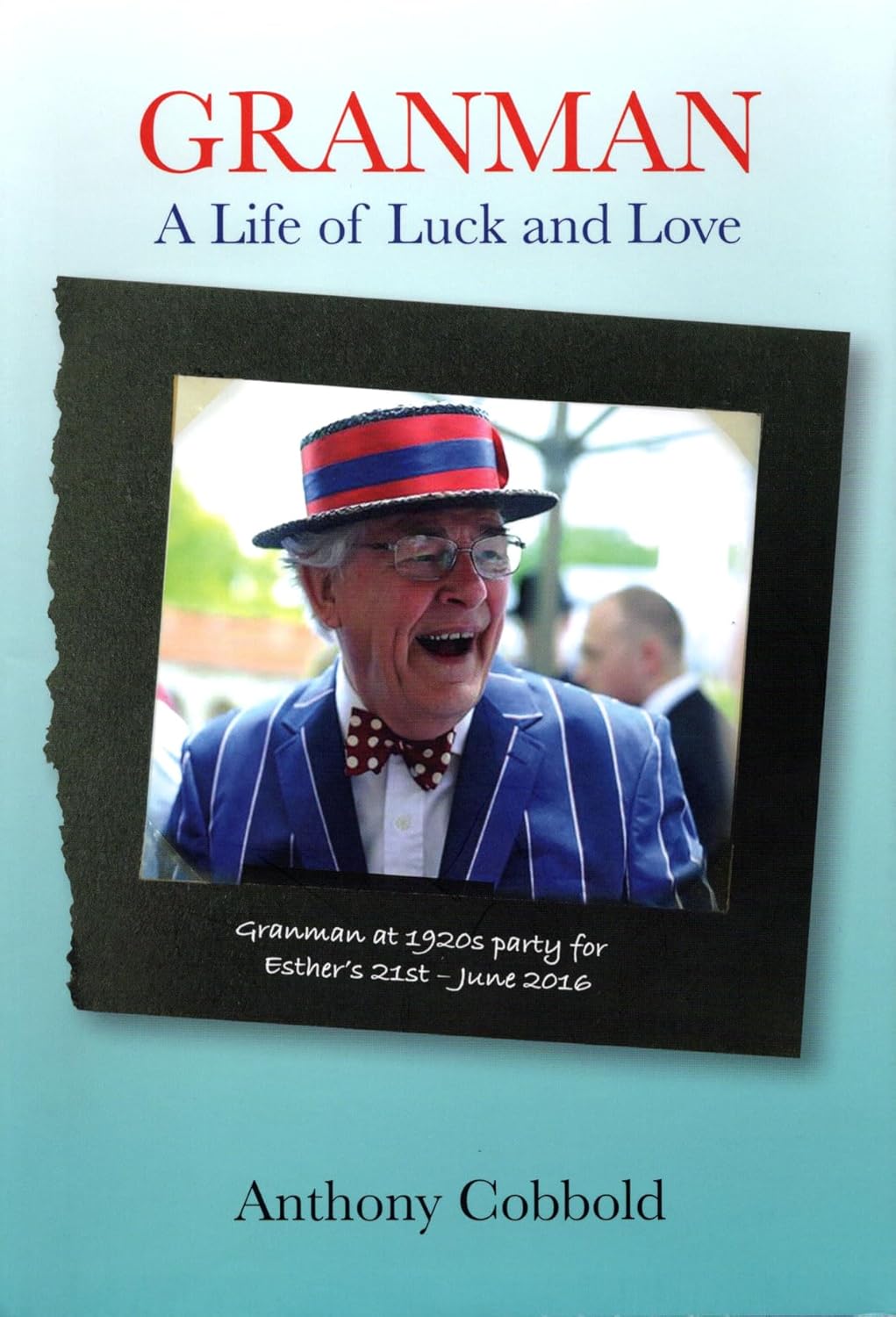
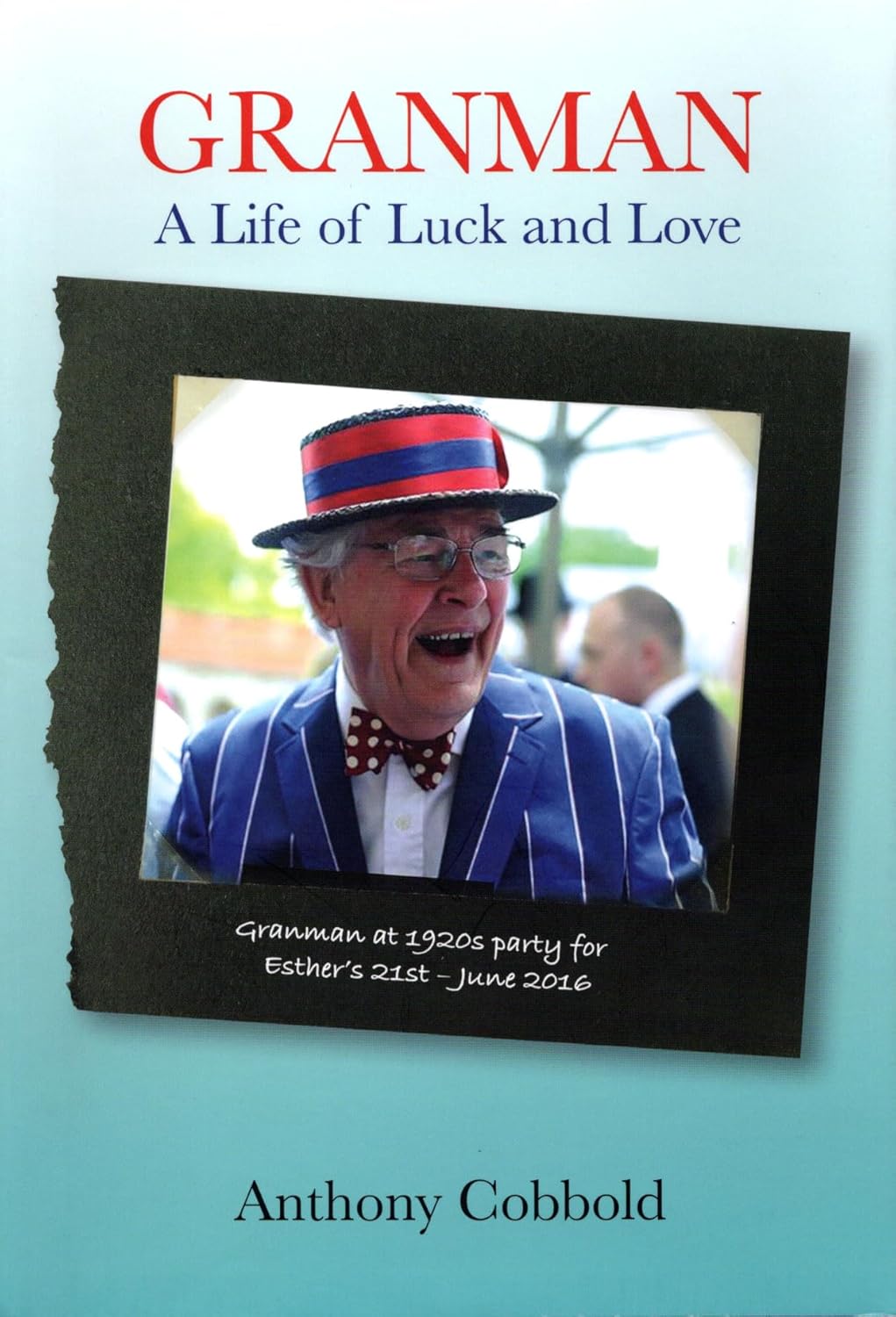
We are pleased to publish reviews and comments following the publication of Granman, written by the founder of The Cobbold Family History Trust, Anthony Cobbold.


A TRULY BEAUTIFUL MEMOIR

Historians of social history will forever be indebted to Anthony Cobbold. He has dedicated his life in retirement to chart the lives and times of his notable East Anglian family with such care and precision. His Cobbold Family History Trust Family Tree is a work of great historical value. This memoir is a wonderful read. Honest, moving and so kind. Anthony has enjoyed a very successful business career, much of it down to his inimitable charm and thought for others. One of the finest memoirs I have read in a very long while. Highly, highly recommended.

Richard, www.amazon.co.uk


Just as the website and vast family tree dealing with the Cobbold family and their kin seems like a patchwork of stories, so the life of Anthony Cobbold. So many places of residence, so many occupations and experiences here and abroad and a number of romantic liaisons… It’s a good read from a self-effacing man who holds Ipswich dear to him.

RG, The Ipswich Society newsletter (October 2024)


If you’ve not had the pleasure to meet our Trust’s founder, Anthony Cobbold, I believe you will find his memoir Granman a truly enjoyable read. If you do know Anthony, you’ll be enchanted – as I was.

Granman tells the story of Anthony’s life leading up to his formation of The Cobbold Family History Trust. It’s a typically self-effacing and beautifully written account of growing up in the war, of the trials of school and university, the ups and downs of a successful career in sales, working in Africa, a passion for cars, the joy and heartache of love, of marriage, children and divorce and, above all, the importance of family.

Henry Lytton Cobbold, Trustee, The Cobbold Family History Trust


Granman is available from The Cobbold Family History Trust’s website at: Granman – A Life of Luck and Love – The Cobbold Family History Trust

Categories
cobbwebs-news-and-views

Felix – The Original Family Historian

Felix Thornley Cobbold (1841-1909) #201 on the web family tree is widely appreciated in Ipswich and indeed throughout Suffolk for his philanthropy.  His gifts of Christchurch Mansion in 1895, the former Ipswich Racecourse and some 852 acres of good agricultural land to the East Suffolk County Council, in trust, are but a few examples.

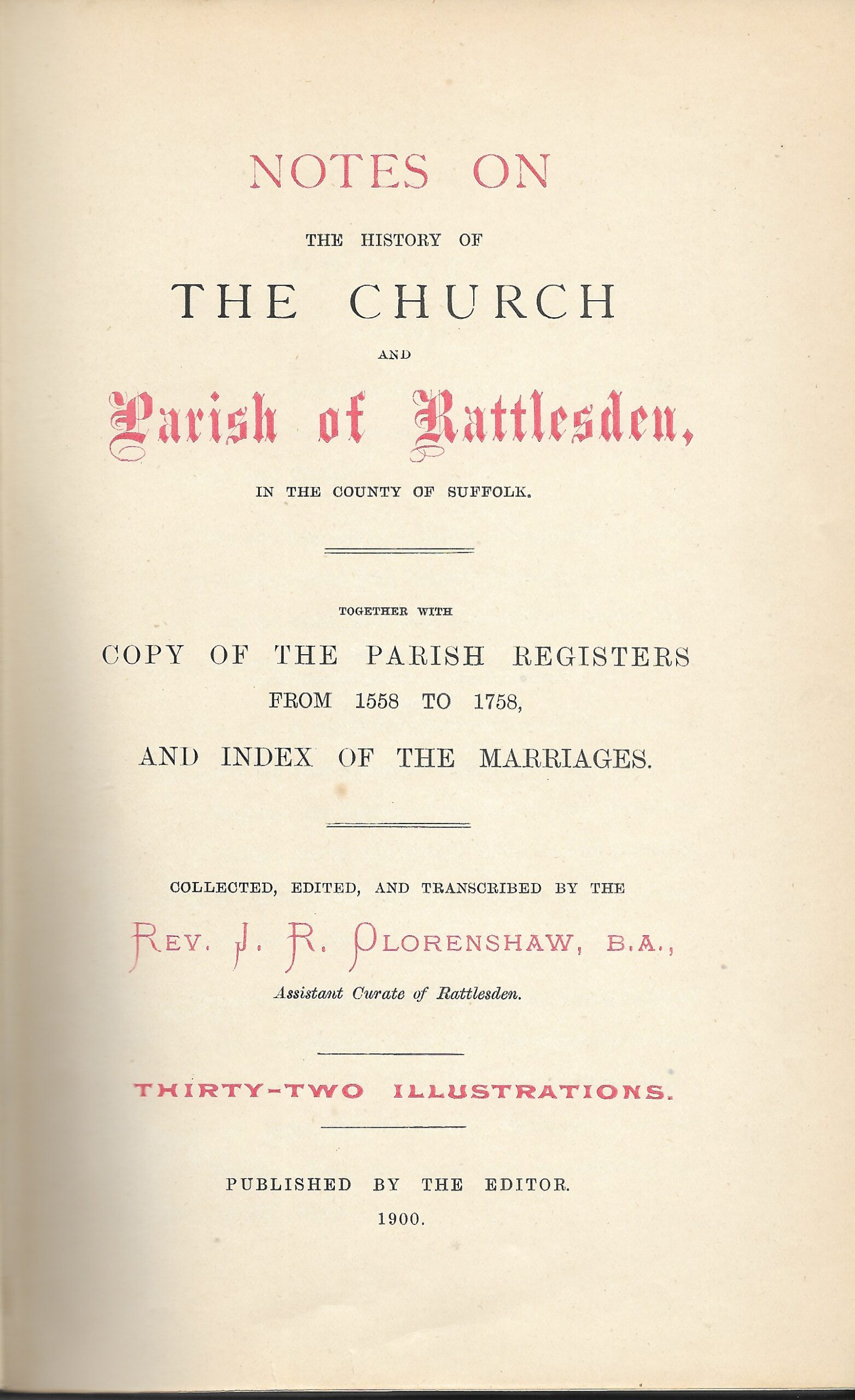
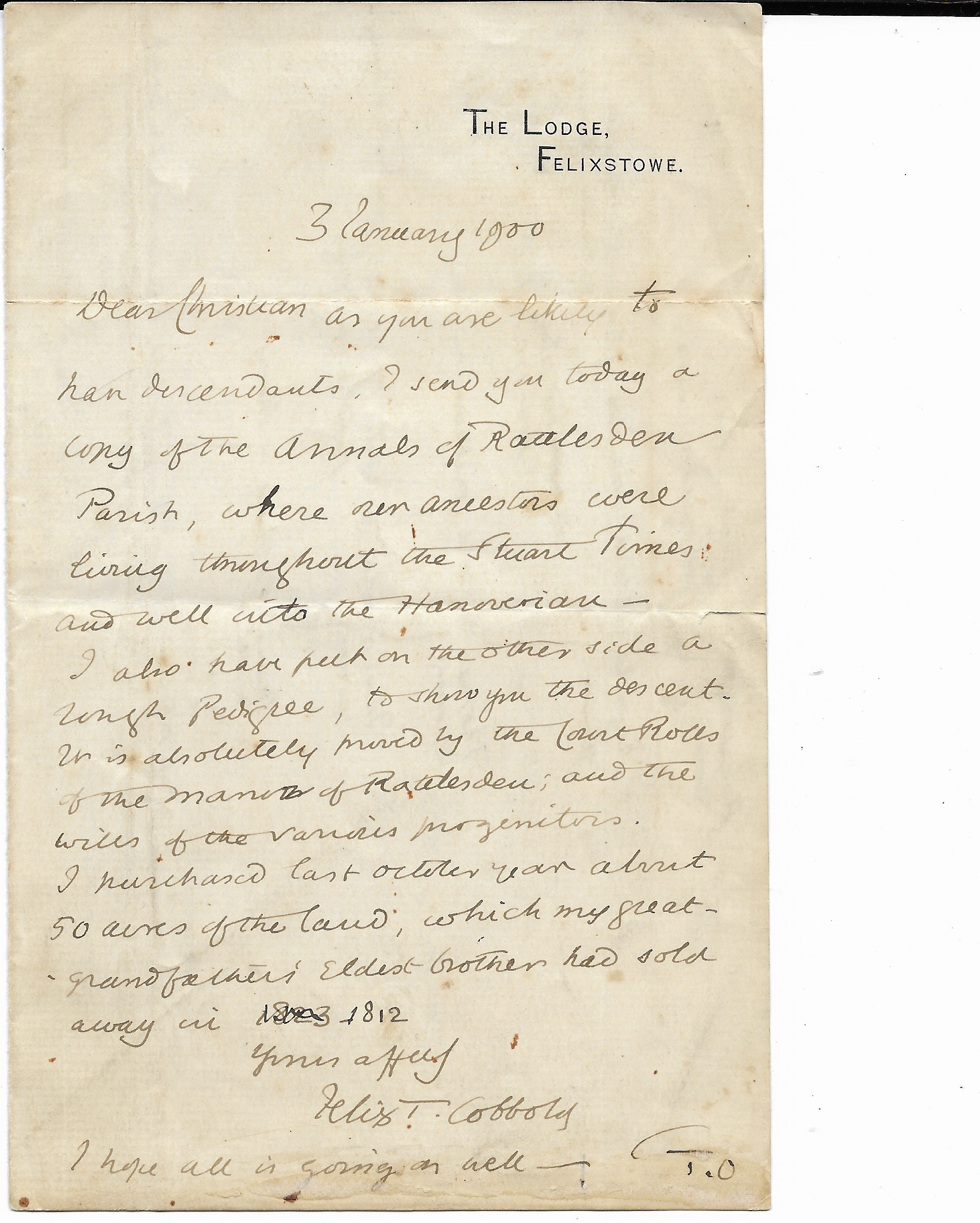
What is not so widely known is that he was the original Cobbold family historian.  In Victorian times when pursuit of family history became fashionable it was deemed desirable to establish a link to royalty whether genuine or fictitious.  We have exposed one such imaginary entry but this was not at all the route taken by Felix.  With an academic background his thorough research was aided by the Reverend Joseph Russell Olorenshaw who produced the Notes on the Church in the Parish of Rattlesden.  On publication in 1900 a copy of this was sent by Felix to Christian Chevallier Cobbold (1868-1910) #341 being passed down to his grandson Richard (Dick) Temple Chevallier (1939) #622.

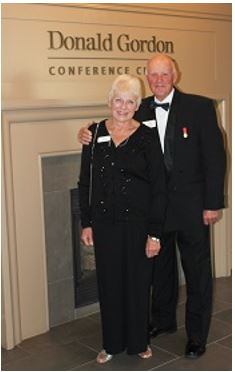
In 2009 Dick and his wife Jeannie née Potter, ardent and much appreciated supporters of The Cobbold Family History Trust, who live in Ottawa donated the book to the Trust on the occasion of Felix’s centenary party at Christchurch Mansion. (For an account of their trip, A Communion of Cobbolds see Cobbweb, Nov. 2009 – click here).  With the book about Rattlesden was a handwritten letter to Christian from Felix including a pedigree for 9 generations of Cobbolds “…where our ancestors were living throughout the Stuart times and well into Hanovarian…to show you the descent.  It is absolutely proved by the Court Rolls of the Manor of Rattlesden; and the wills of the various progenitors.”  Felix’s work, checked and unaltered, forms the basis of the family tree we see and love today.

A little aside on the pedigree says that Rev. Thomas Cobbold (1742-1831) #51 sold the Rattlesden property to Cocksedge in 1812.  The last paragraph of Felix’s letter sounds a mildly triumphal note: “I purchased last October year about 50 acres of the land which my great grandfather’s eldest brother sold away in 1812.”

The original letter and Felix’s copy of the limited (to 200) edition of the book are now preserved in perpetuity in the Trust archive.  Thank you, Dick and Jeannie.

Anthony Cobbold
0
    0
    Your Cart
    Your cart is emptyReturn to Shop