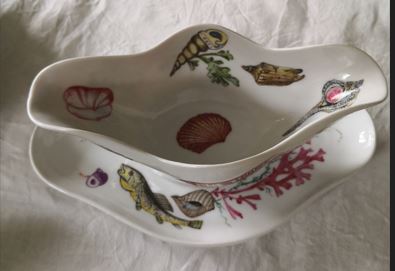
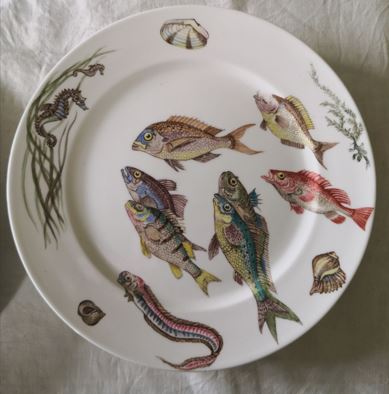
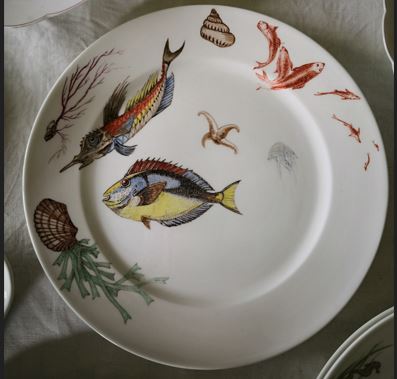
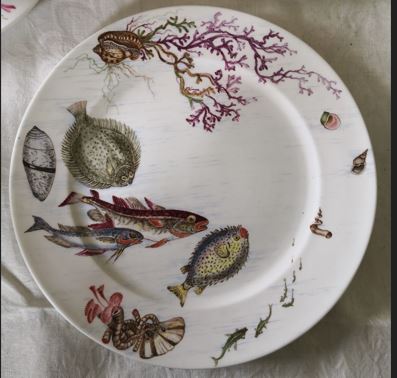
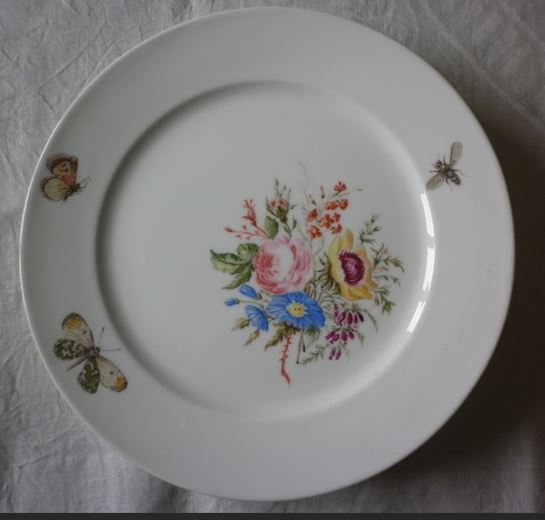
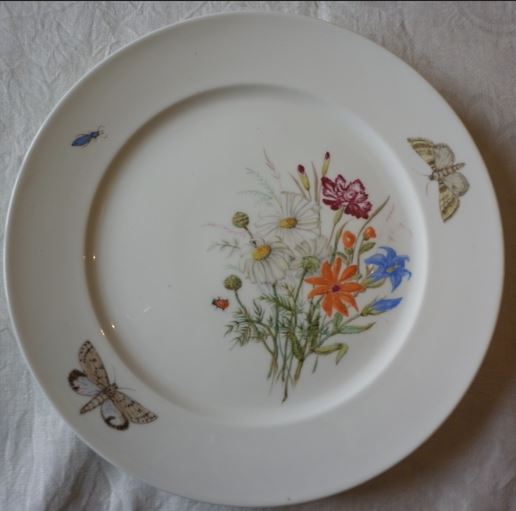
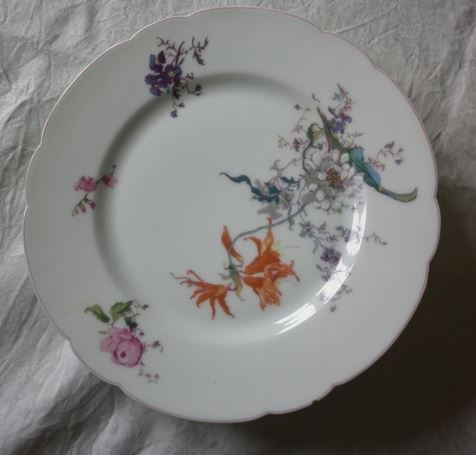
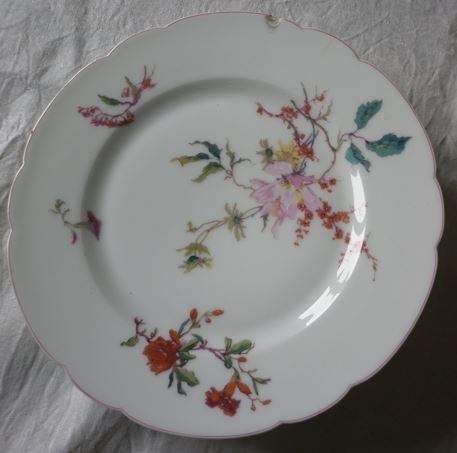
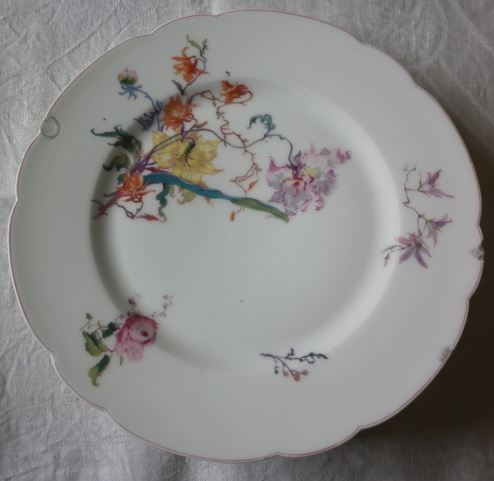
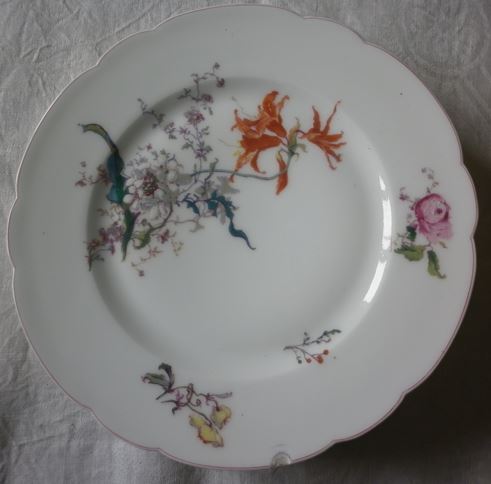
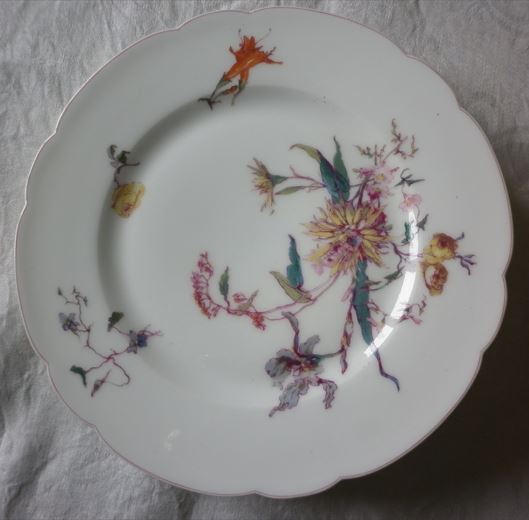
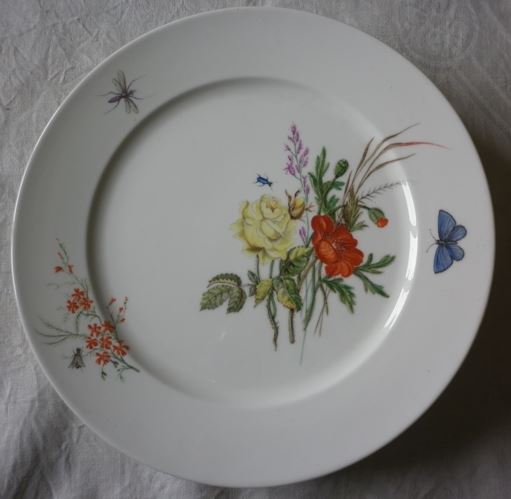
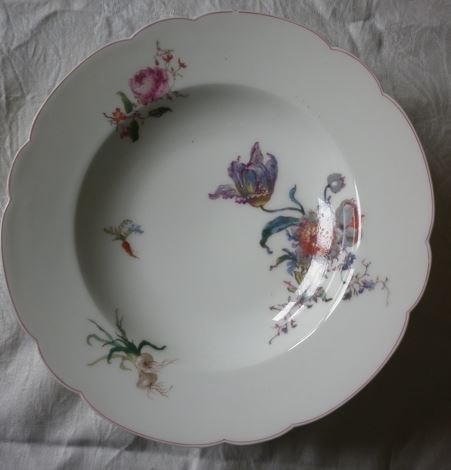
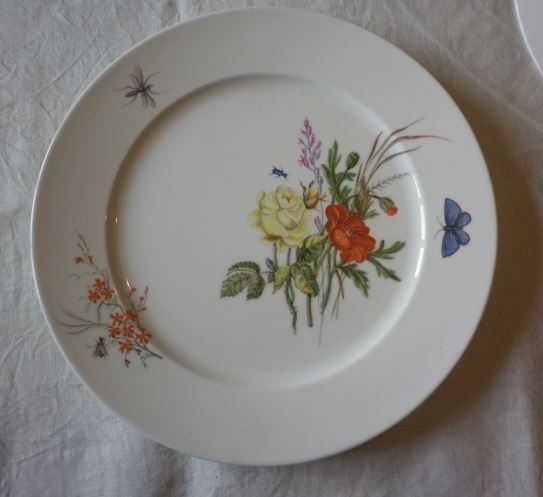
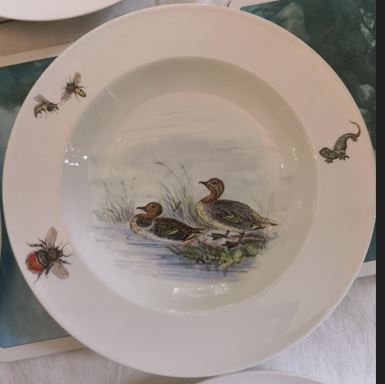
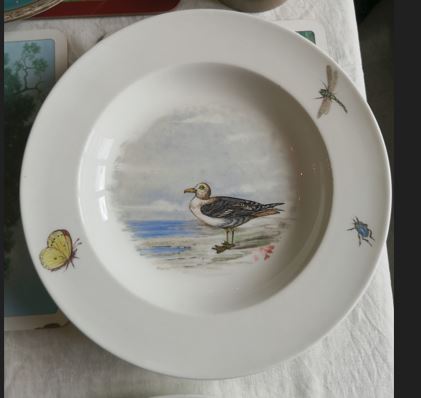
Charlotte’s heraldic plates, which we looked at last month, were by no means her only artwork. She exhibited paintings with Suffolk Artists which had been founded in 1832 by Henry Davy(1793-1865) and counted amongst its members, John Chevallier Cobbold (1797-1882) #114 and Richard Cobbold (1797-1877) #106.
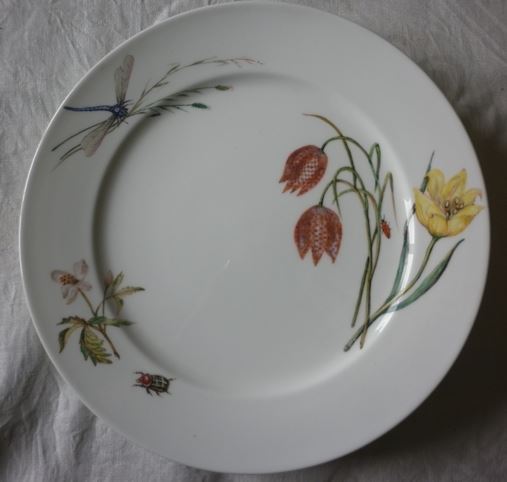
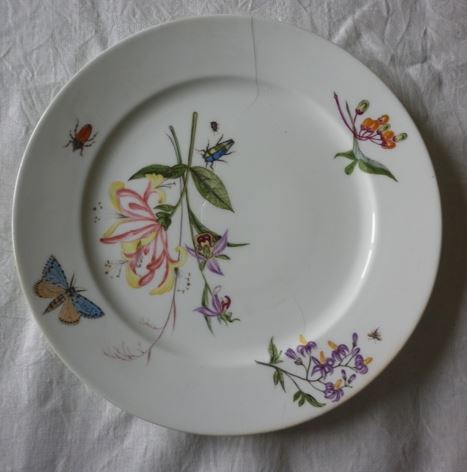
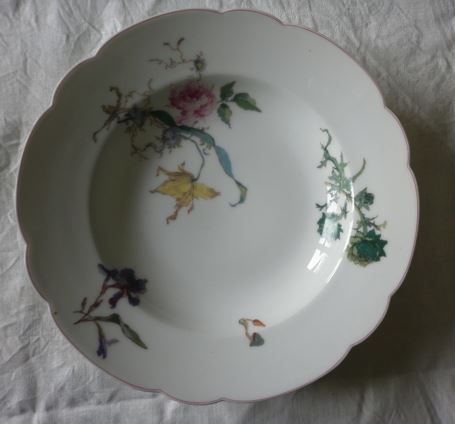
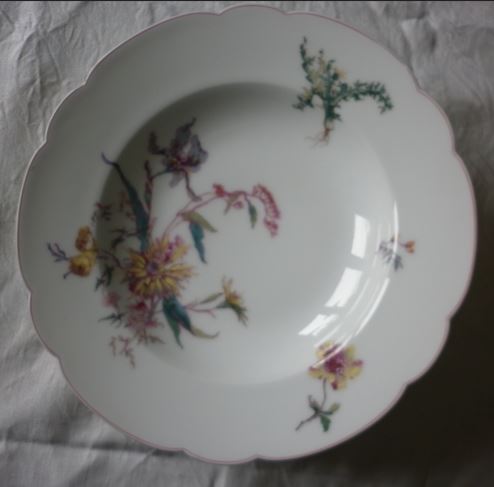
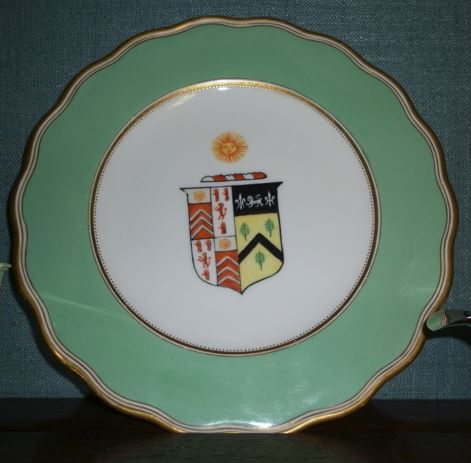
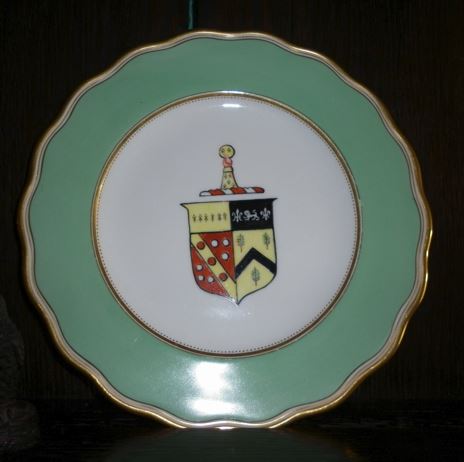
Charlotte Bampton née Cobbold (1817-1914) #141 also left us exquisite decoration on mainly Limoges porcelain of which we show a selection here, all executed, as far as we can tell, between 1876 and 1884. Porcelain manufacture started in Limoges around 1771.
Pictures are courtesy of a generous family member, thank you.
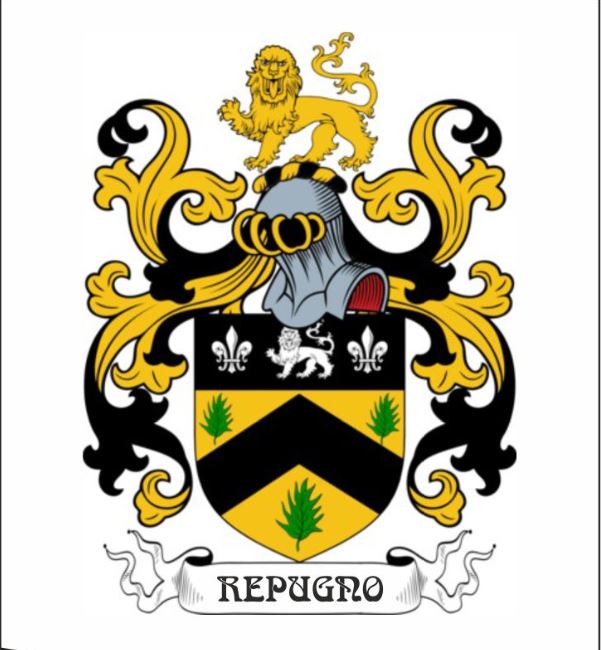
The original Cobbold coat of arms as near as we can tell at present.
Heraldry is an extensive and complicated subject. Three of my grandchildren and one of their spouses gave me for Christmas a copy of Simple Heraldry. Published in 1978 the authenticity of the work (and perhaps the complexity of the subject matter!) are indicated by the grandeur of the authors’ titles: Sir Iain Moncreiffe of that Ilk BT., O.S.T.J., PH.D., F.S.A., Advocate, Albany Herald of Arms and Don Pottinger, O.ST.I., M.A.(Hons), D.A Unicorn Pursuivant of Arms. Nevertheless, the book tells us that the component parts of a full ‘achievement’ are correctly called, from the top down, the Crest, the Helmet, the Mantling, the Coat of Arms, and the Motto. Some have Supporters on either side and Supporters stand on a mound called a Compartment. Not all Coats of Arms have all components.
Over time variations creep in but as far as we can deduce the coat of arms shown here (1) as Cobbold are pretty much what the original family arms looked like. The Mantling appears above the helmet whereas it should perhaps be below.
Charlotte Bampton née Cobbold (1817-1914) #141, a daughter of John Wilkinson Cobbold and Harriet Chevallier was an accomplished artist with a leaning towards family history, who recorded the marriages of seven of one of her brothers and six sisters on plates. In the language of heraldry, a union is called ‘impaling’ and is indicated by a vertical line down the centre of the shield (‘per pale’). As we look at it, the husband’s coat is always on the left (dexter or baron) and the wife’s father’s coat on the right (sinister or femme).
In 1827 John Chevallier Cobbold (1797-1882) #114 married Lucy Patteson (1800-1879) #115
In 1832 Katherine Georgiana Cobbold (1806-1885) #125 married Rev. William CharlesFonnereau (1806-1855) #126
In 1833 Emily Cobbold (1809-1902) #129 married George Read Dixon (1808-1839) #130
In 1835 Harriet Anne Cobbold (1811-1864) #132 married (secondly) Edward Hanbury (1808-1850) #133
In 1842 Agnes Cobbold (1807-1895) #127 married Rear-Admiral Frederick Chevallier Syer (1799-1874) #128
In 1843 Jane Octavia Cobbold (1819-1888) #143 married Rev. O Thomas Preston (1817-1897) #144
In 1855 Harriet Anne Cobbold (1811-1864) #132 married (thirdly) Borlase Hill Adams (1817-1885) #135
Charlotte had another eight brothers and sisters and we have some unidentified heraldic plates but to date we have failed to find more matches.
Anthony Cobbold
The original Cobbold coat of arms as near as we can tell at present.
Cobbold & Patteson
Fonnereau & Cobbold
Dixon & Cobbold
Hanbury & Cobbold
Syer & Cobbold
Preston & Cobbold
Adams & Cobbold
Footnote: Having consulted the family’s classical scholar, we believe the original motto was ‘Repungo’ being translated as ‘Prick back’ (holly leaves) suggesting a defensive stance. It is thought to have been changed to ‘Repugno’ in Victorian times translated as ‘Fight back’ or ‘Retaliate’ to give an altogether more aggressive feel.
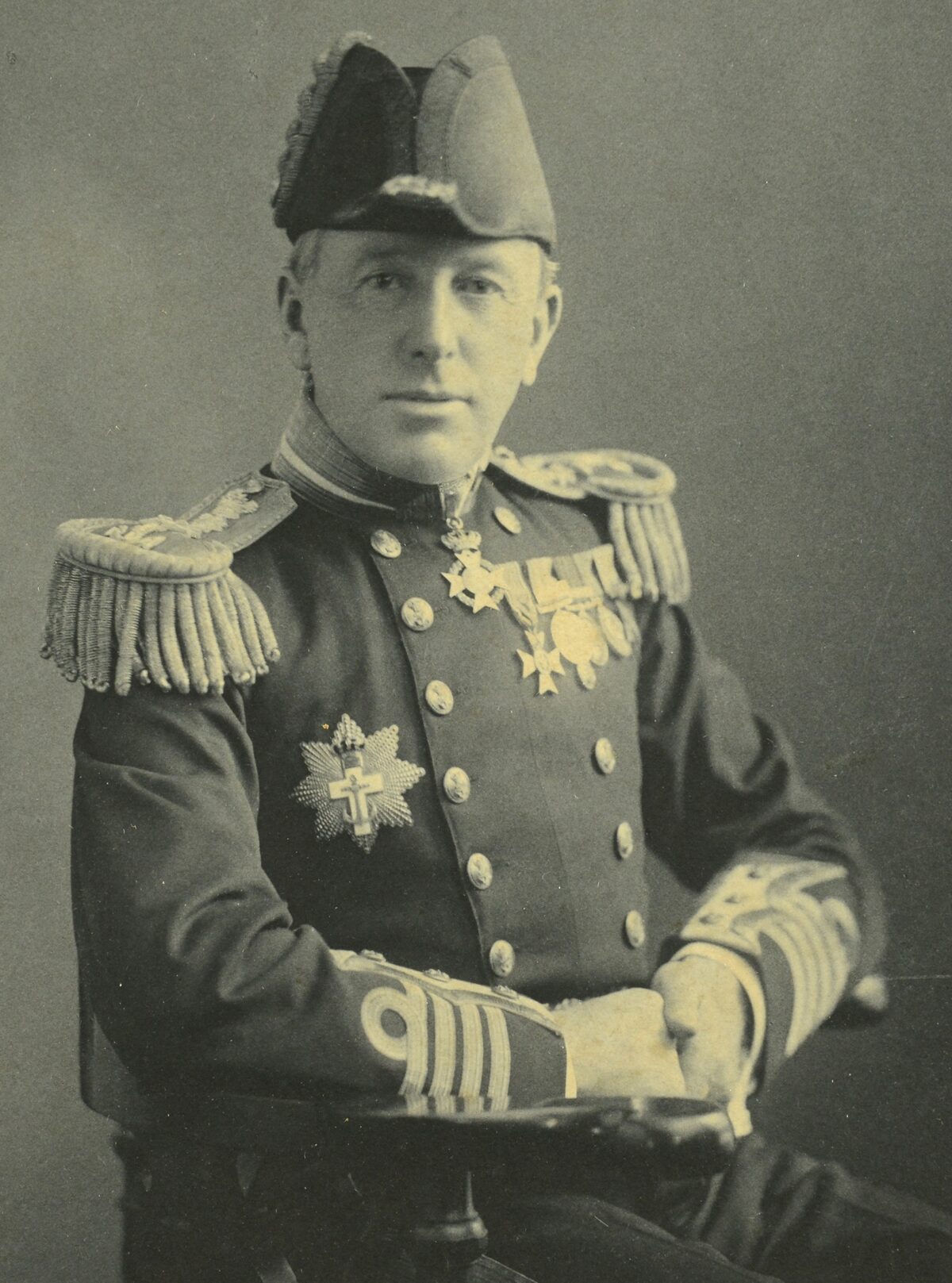
The Graves-Sawle family appears on the Cobbold family tree because of the marriage of Col.Ralph Patteson Cobbold (1869-1965) #316 to Rosemary Graves-Sawle (1890-1971) #319, daughter of Rear-Admiral Sir Charles John Graves-Sawle MVO 4th Bt. (1851-1932) #2535.
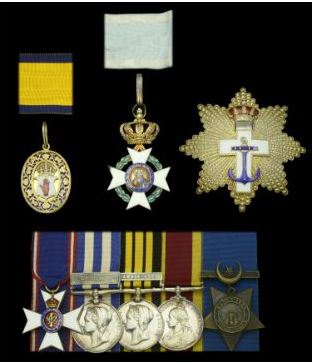
A group of the Rear-Admiral’s awards came up for auction recently but, with a guide price around £4000, it was well beyond our means. The collection comprised his Baronet’s Badge, his MVO (Member of the Victorian Order) and eight medals awarded during his distinguished naval career.
His obituary in The Times tells us:
He entered the Royal Navy in March 1865. He served in the Hercules and Bellerophon and was promoted to Lieutenant in April 1876. He went to the Mediterranean in October 1880 as Lieutenant of the Superb and served there about six years. He was present at the bombardment of Alexandria in July 1882 and during the operations of the Egyptian War, for which he received the Medal with clasp ‘Alexandria 11th July’ and the Khedive’s Bronze Star.
In 1888 he became Second in Command of the Canada on the North American Station. He was appointed in January 1890 as First Lieutenant of the battleship Anson, Flagship of Rear-Admiral Tracey in the Channel Squadron and was promoted to Commander in 1890.
The following summer he went to the Cape as Commander of Raleigh, Flagship of the Commander in Chief Rear Admiral Sir Frederick Bedford KCB. [Admiral Sir Frederick GeorgeDenham Bedford GCB GCVO (1838-1913) – later Governor of Western Australia – also appears on the Cobbold family tree married to Ethel Turner (1856-1932) #15236, daughter of Edward Rush Turner (1823-1904) #15210 of Ipswich, a pioneering agricultural engineer whose company, E R & F Turner achieved international fame.] It fell to the Rear-Admiral to conduct certain punitive expeditions in West Africa in one of which Commander Graves-Sawle took a prominent part.
After Flag Captain Gamble had been wounded, he took command of the Naval Brigade landed from Raleigh, Alecto, Satellite, Magpie and Widgeon at Bathurst, on the River Gambia, in February 1894, in co-operation with two companies of the West India Regiment, to punish a rebellious slave trading chief named Fodi Silah. For his services he was Mentioned in Despatches and received the General Africa Medal with clasp ‘Gambia 1894’.
In the following August he received his first independent command, the light cruiser Mohawk, in North American waters and in December 1896 he was promoted Captain. His first service as Captain was as Flag Captain to Vice-Admiral Sir Frederick Bedford [with whom he had served previously] in Crescent, on the North American Station. In 1900 he went to China as Captain of the Bonaventure. As Captain of the cruiser Aboukir in the Mediterranean on the occasion of King Edward’s visit to Malta in 1903 he was made MVO. Following his father’s death in April 1903, and the death of his brother without issue in August of the same year, he succeeded to the Baronetcy and property. He did not seek another appointment and retired. He was ADC to King Edward VII in 1906 and was advanced to Rear-Admiral on the Retired List in 1907. He became High Sheriff of Cornwall in 1913.
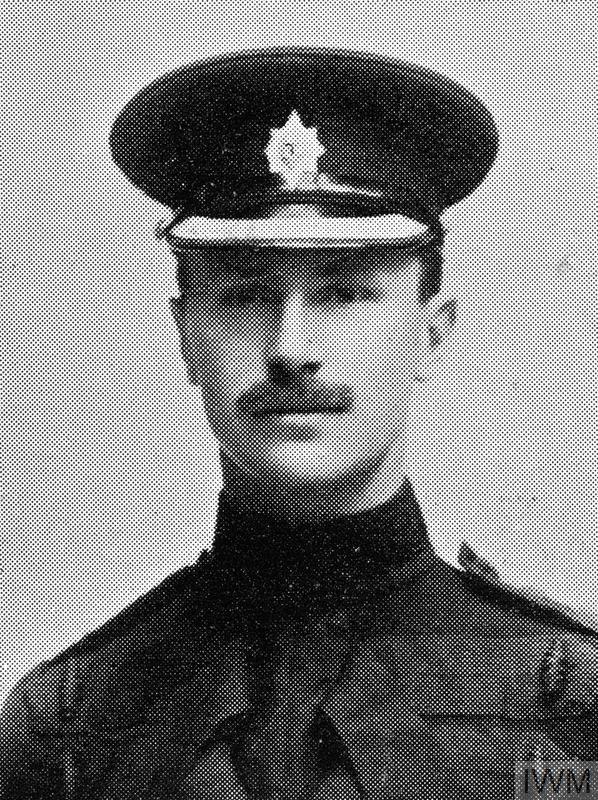
His son, Lieutenant Richard Charles Graves-Sawle (1888-1914) #8052 who served with the Coldstream Guards at Ypres was killed by a sniper in November 1914. He died without male issue which means that the Baronetcy became extinct. However, Richard’s image was chosen by Danny Boyle (of 2012 Olympic Games opening ceremony fame) to be one of 28 Heroes’ faces etched in the sand around the UK as an Armistice Centenary tribute. Richard was portrayed on Porthcurno Beach in his native Cornwall.
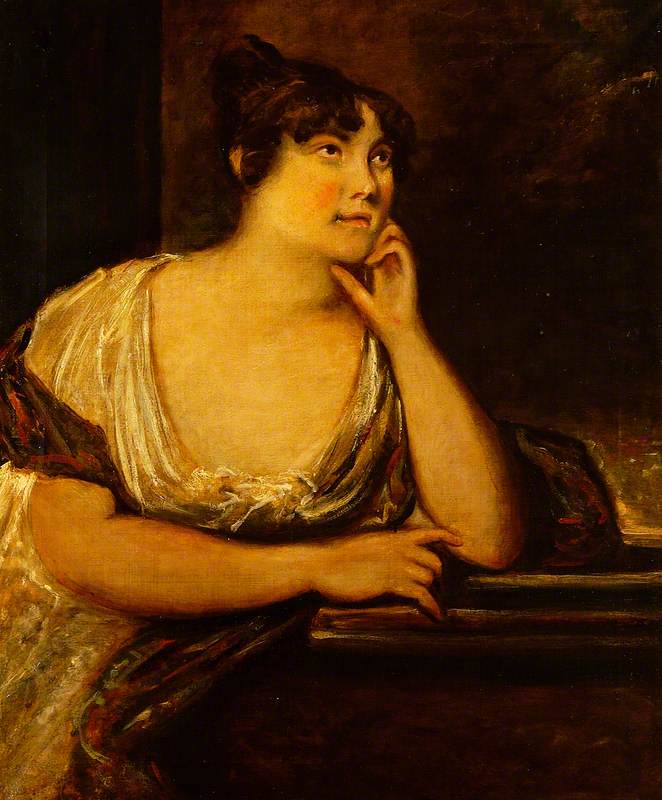
When I first met Lady Blanche (1898-1987) #449 at Glemham Hall in the 1980s she showed me the family portraits which included those of John Cobbold (1745-1835) #56 and Elizabeth Cobbold née Knipe (1765-1824) #58, both painted, probably at about the same time, by Daniel Gardner (1750-1805) and both identified as being his work.
As time went on, I became aware that on many occasions when these portraits were reproduced, they were said to be by George Frost (1754-1821). As recently as Valentine’s Day this year the Ipswich Star used the image of Elizabeth Cobbold, and quoted it as being by artist George Frost and in the public domain.
A year or two ago I set out to resolve the issue by consulting the admirable EmmaRoodhouse, the Art Curator for Ipswich Museums. She thought that copies may have been made by George Frost. Investigating Frost more closely myself I observed that most of his paintings were of places and I learned that Frost was a keen admirer and copier of ThomasGainsborough (1727-1788). I found no specific evidence of Frost being in touch with the Cobbolds.
Two books printed by E. Shalders of Ipswich (Poems by Elizabeth Cobbold and ValentineVerses by Richard Cobbold), both about 1827, contained black & white prints of the portraits clearly identified as ‘Gardiner pinx’ (meaning ‘painted’) and ‘Worthington sculp’ (meaning ‘engraved’). This lent weight to my belief in Gardner but I noticed that his name had been misspelled!
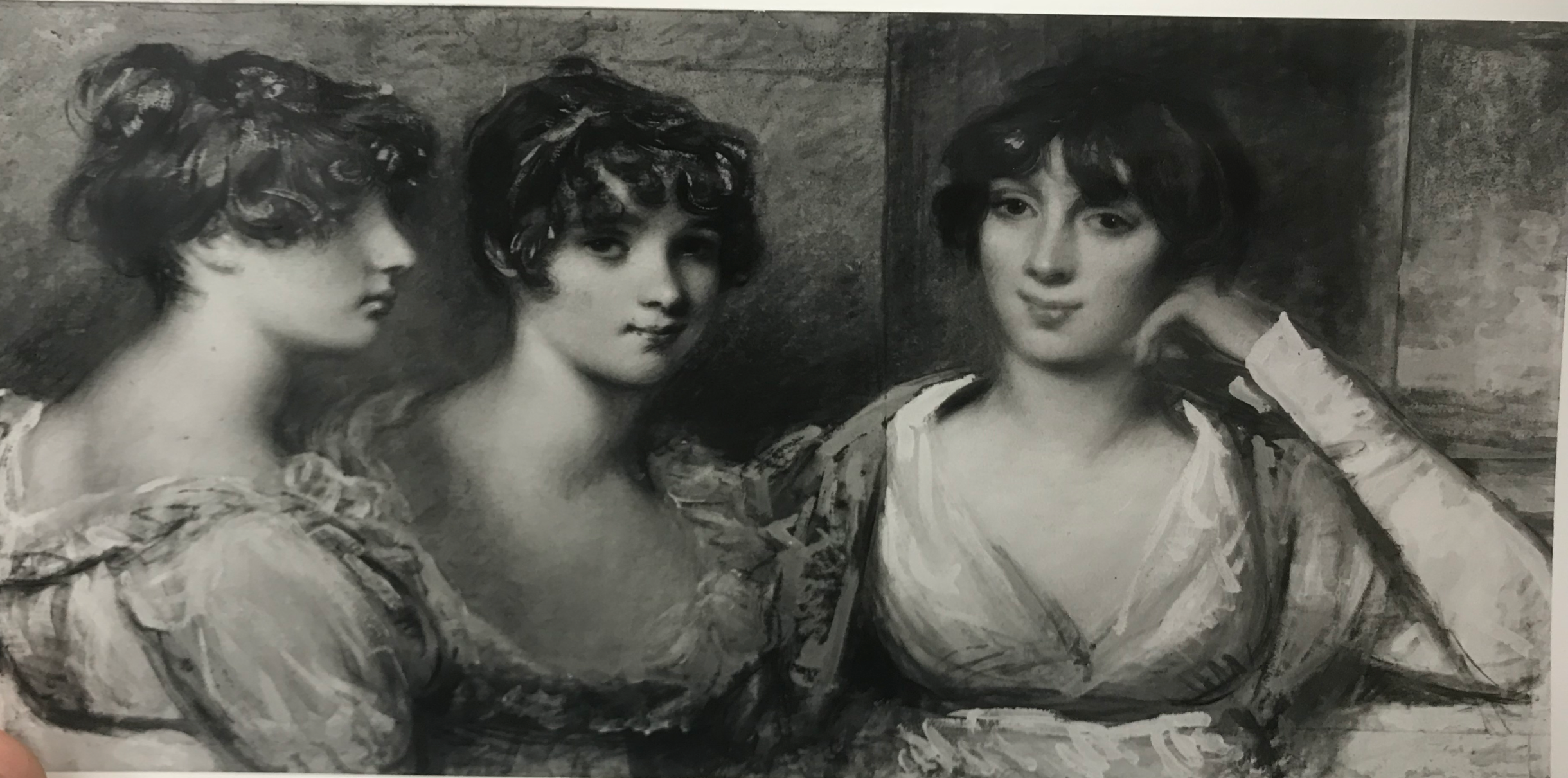
I had known for some time that Daniel Gardner had portrayed ‘The Three Misses Cobbold’, being three of the eight daughters of John Cobbold of Holy Wells [sic], by his first Elizabeth. It is difficult to know which three daughters they were but my best estimate is that they are Anne (1784-1806) #89, Harriet (1785-1877) #91 and Sophia (1787-1832) #96.
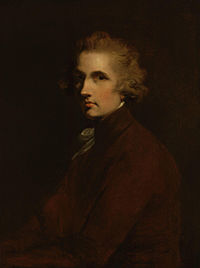
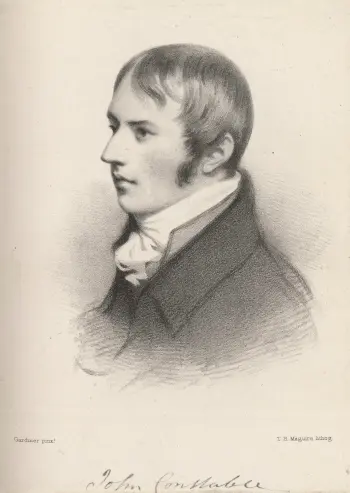
Recently, I was able to purchase a copy of the catalogue for the Daniel Gardner Exhibition staged by the Greater London Council at Kenwood House in 1972 in which The Three Misses Cobbold was displayed. In her description of the exhibits Helen Kapp, the Curator mentions that May 25th 1793 was the date on which Mrs. Cobbold, Gardner and John Constable (1776–1837) ‘sat sketching under the lime trees which then fronted the small dwelling house adjoining the more lofty buildings of the brewery.’ ‘A warm friendship grew up between these two – so distant in age – which later became significant to Constable. Possibly to Gardner too. Certainly, the friendship was close enough for Gardner to have painted Constable’s portrait’ which was also exhibited.
Gardner’s family was well respected in Kendal and his mother was a talented amateur draughtsman and painter in watercolours, all of which supports the widely-held view that Daniel’s family was well known to the Knipes, even from before the time of Elizabeth’s birth. With so much contact between families I am now convinced that those two all-important portraits were indeed the work of Daniel Gardner.
March 2010 saw the start of our story about Nicky Cobbold (1997) #1079. He was 12 at the time and had Down Syndrome and Leukaemia. Having survived open heart surgery aged 2, he had already endured more trauma and ill health than any child should have to face.
Despite having been diagnosed with Grave’s disease, our report on Nicky in October 2016 found him helping out at Camp Curumbene in Corop, Australia which provided out-of-school activities for 130 children. In addition to canoeing, dancing, and helping judge the ‘Camp Curumbene’s Got Talent’ show Nicky loved just chatting with the children. What he probably didn’t realise was that he was showing them that children with a disability are no different from themselves.
However much we may talk to our children about others with a disability, there is nothing like giving them the opportunity to find out for themselves. For many, Nicky was the first disabled child they had ever met, and in Nicky they found the warmest, kindest, friendliest and most affectionate person imaginable. They would discover that he does not have a mean bone in his body and that he bubbles with enthusiasm for life every day.
Now, would you believe we find Nicky featuring in “Making Waves” the journal of a body which provides sailing opportunities for people with a disability.
Celebrating World Down Syndrome Day with our Star Volunteer, Nicky
Today, 21st March we are celebrating World Down Syndrome Day – a day to recognize and appreciate the incredible contributions of people with Down Syndrome all around the world. And what better way to celebrate than by giving a huge shoutout to one of our absolute legends, Nicky! If you have been around RGYC [Royal Geelong Yacht Club] on a Wednesday morning, you have probably met Nicky. He is a superstar volunteer, always bringing good vibes and showing our participants that having a disability doesn’t define you. But Making Waves is just one of the many places he makes a difference – Nicky also helps out at The Yot (RGYS’s café), works at a local real estate agency, takes part in Back to Back Theatre, plays footy and still finds time to hit the dance floor on Wednesday nights.
Nicky, you are an inspiration to us all, and we are so lucky to have you as part of the team. Keep being awesome!
Before continuing with Mrs Bulwer Lytton’s major alterations at Knebworth we step back to earlier days, as described by Sibylla Jane Flower in her article in Country Life dated January 31st 1985:
Before Mrs Bulwer Lytton (1770-1843) [#9163 on the web family tree], inherited Knebworth, she spent most of her life in a neat terrace house in Marylebone, except for the years 1798 to 1807 when she was married to General Bulwer (1757-1807) [#9162] of Heydon Hall in Norfolk. Having settled herself once again in London after his death she must have viewed with horror the dilapidated mansion which came to her with very little money when her father died in 1810.
Knebworth had been let to tenants since the death of her great-uncle, John Robinson Lytton in 1762, but Mrs Bulwer Lytton was a woman of courage and determination with a strong sense of pride in her own family – the Lyttons. She was determined to rescue the house which, alone among all his extensive properties her spendthrift father had been legally unable to sell. She asked the architect John Biagio Rebecca to advise her, and the plans he drew up in 1813 show the gradual scaling down of her ambitions…
The Lytton family connection with Knebworth began in 1492 when Sir Robert Lytton acquired the reversion of the manor from Sir Thomas Bourchier. By this date the place had a history stretching back at least to the time of Edward the Confessor. William 1 granted the manor and fort [there’s a rather different fort today!] of Knebworth to one of his favourite courtiers, a generous gesture to judge from the description given in the Domesday survey. Knebworth was in the de Brotherton family until the end of the 14th century when it was acquired by another royal favourite, John Hotoft [who
was keeper of the wardrobe to Henry VI]. It was after the death of Hotoft’s grand-daughter, Lady Bouchier, that Sir Robert Lytton was able to establish himself at Knebworth, about 1500.
Young Robert fought at the Battle of Bosworth and became a firm favourite of Henry VII who rewarded him handsomely for his loyalty. Until 1705, when the direct line died out seven generations of Lyttons, named Robert, Rowland or William, succeeded one another at Knebworth.
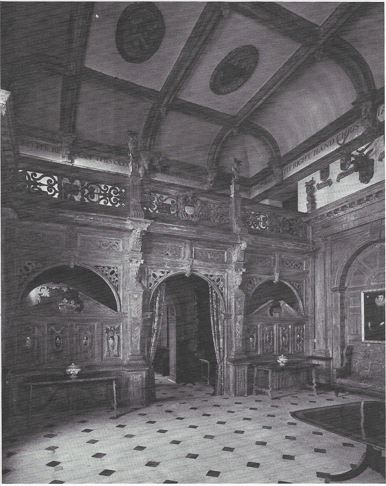
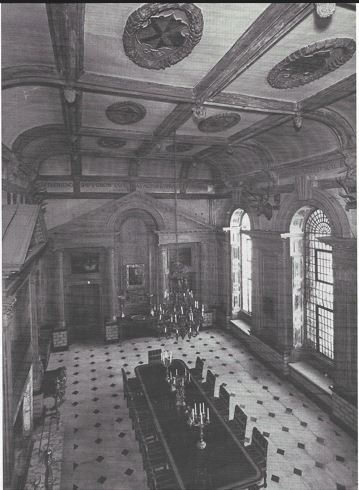
It was during this period that two of Knebworth’s most distinguished architectural features were created. The great oak screen in the hall is of three bays with semi-circular arched openings, the central one of which is flanked by caryatids [sculpted female figures serving as architectural supports taking the place of columns] on tapering pedestals. At about the same time, the other great feature, the coved ceiling, was installed in the Great Hall with its moulded oak principles, ribs, cornice, and fantastic brackets of animal heads.
Anthony Cobbold
Mrs Bulwer Lytton #9163
Sir Robert Lytton (1438-1505)
The Jacobean Screen in the Great Hall
The Great Hall prior to the removal of the Gothic Revival glazing.
Images courtesy of Knebworth House (www.knebworthhouse.com).
This is a tale of little consequence but it illustrates the small pleasures that derive from a careful look at the papers left by our parents.
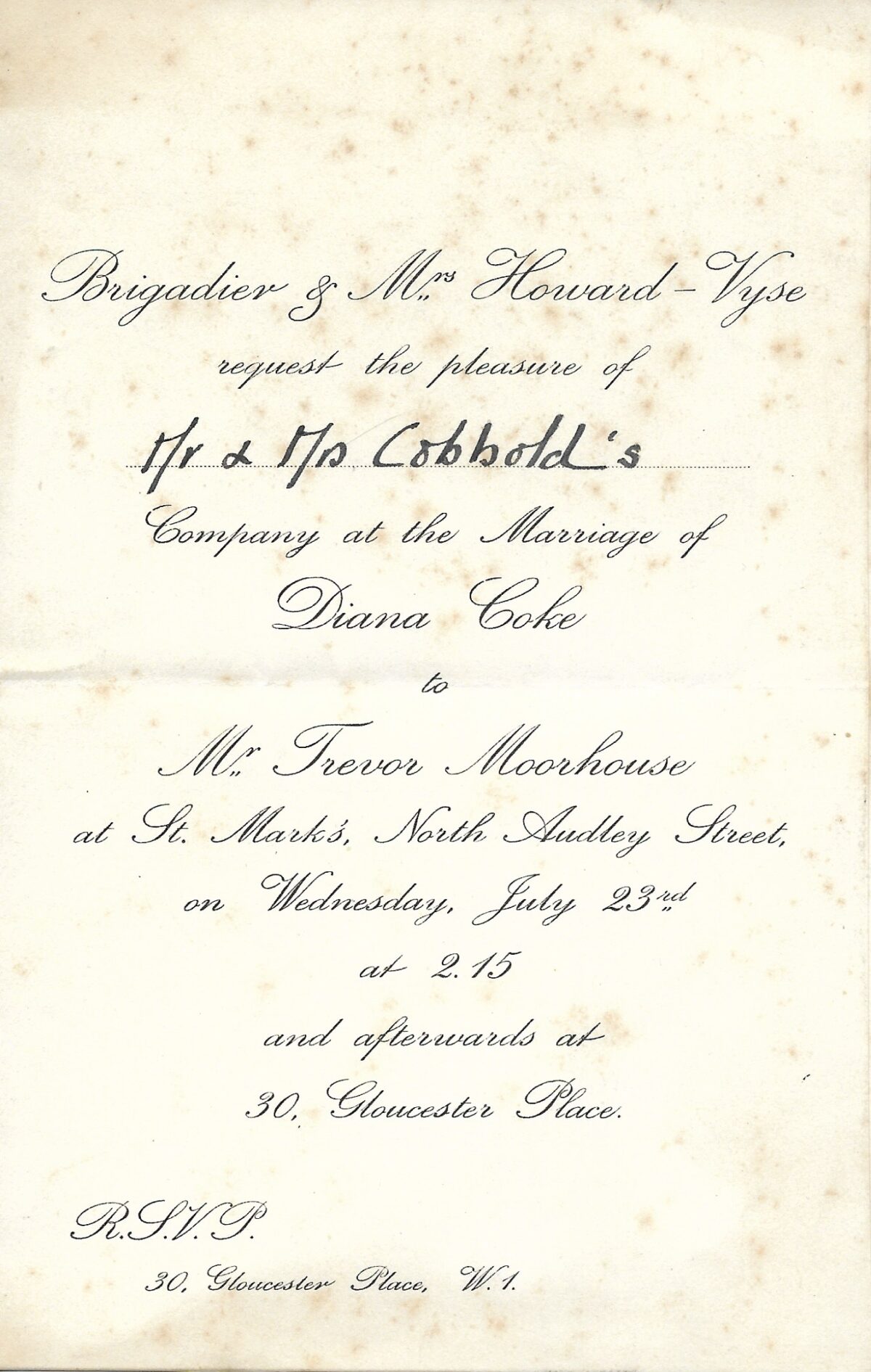
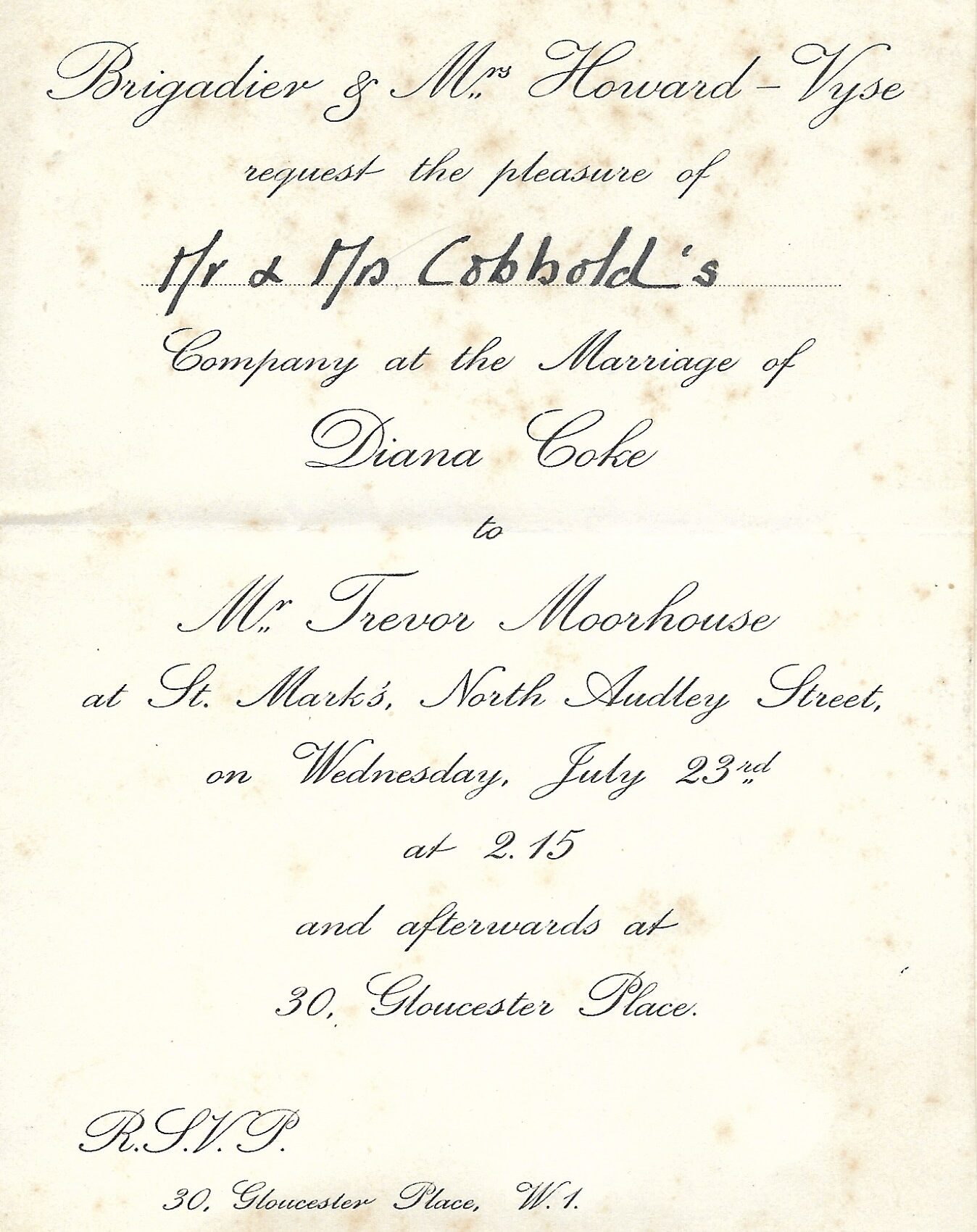
Three years ago, I chanced to meet a lady whose married name was Moorhouse. Going through my father’s papers I found a wedding invitation from 1930. I would have cast it aside but I noticed the groom was a Moorhouse. Looking more carefully, I saw that the bride was Diana, a niece of the 4th Earl of Leicester. Knowing that Lady Evelyn Cobbold (1867-1963) #308 on the web family tree was a granddaughter of the second Earl I wondered why my young, impoverished, newly married parents had been invited to this undeniably posh wedding at St. Mark’s, North Audley Street.
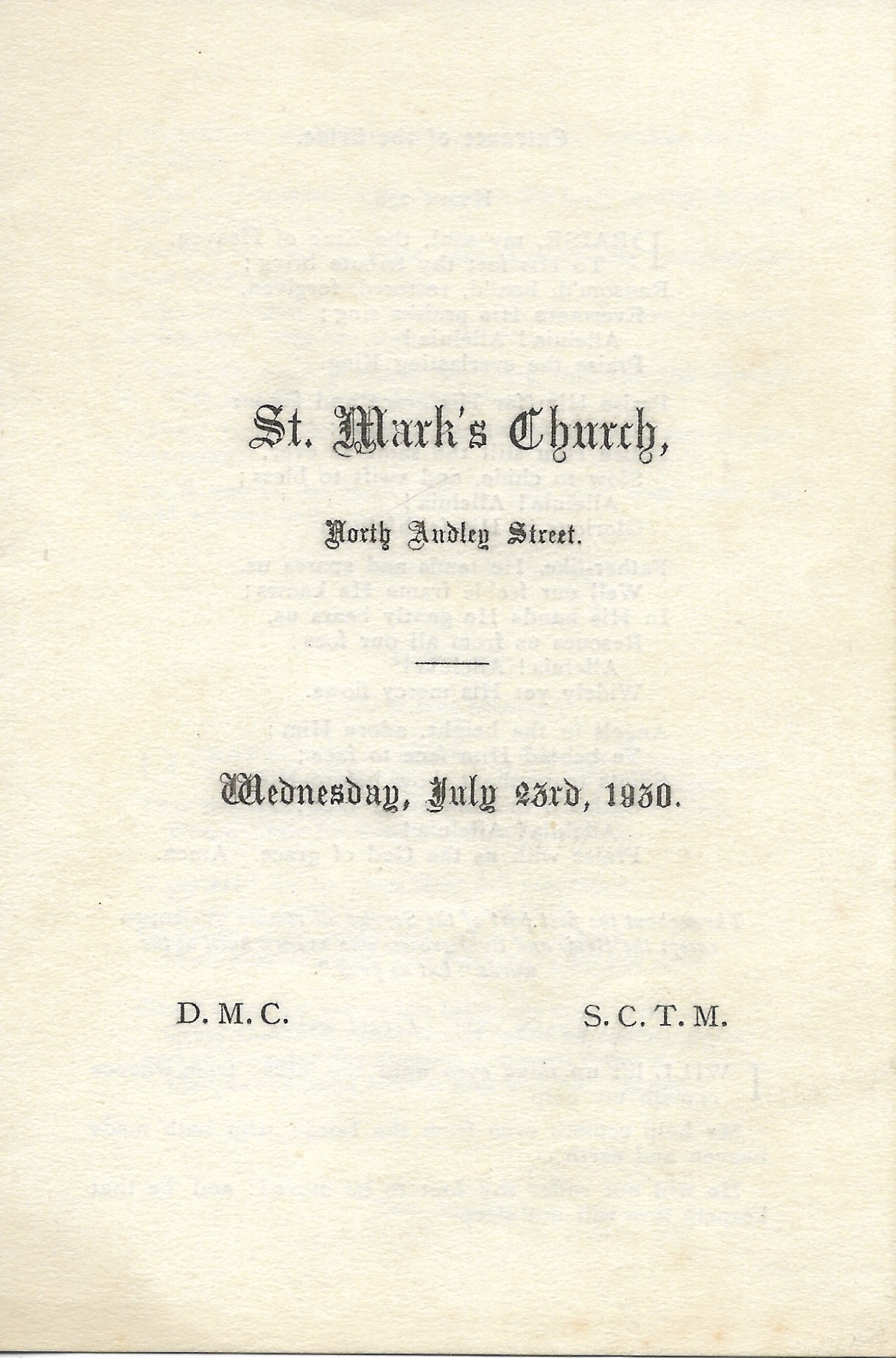
Thinking about it I guessed that Diana had had a crush on my mother Mary(1908-2000) #408 when they were at school together and she just wanted her there on her big day. A little later, and I found the Order of Service for the ceremony bearing the initials DMC for Diana Meriel Coke (1907-1996) #15293 and SCTM for Samuel Cecil Trevor Moorhouse (1908-1975) #15305. One of the hymns, sung kneeling, was ‘O Perfect Love, all human thought transcending…’ The reception was at 30 Gloucester Place, which was a fine Georgian property in its day but which is currently being converted into flats.
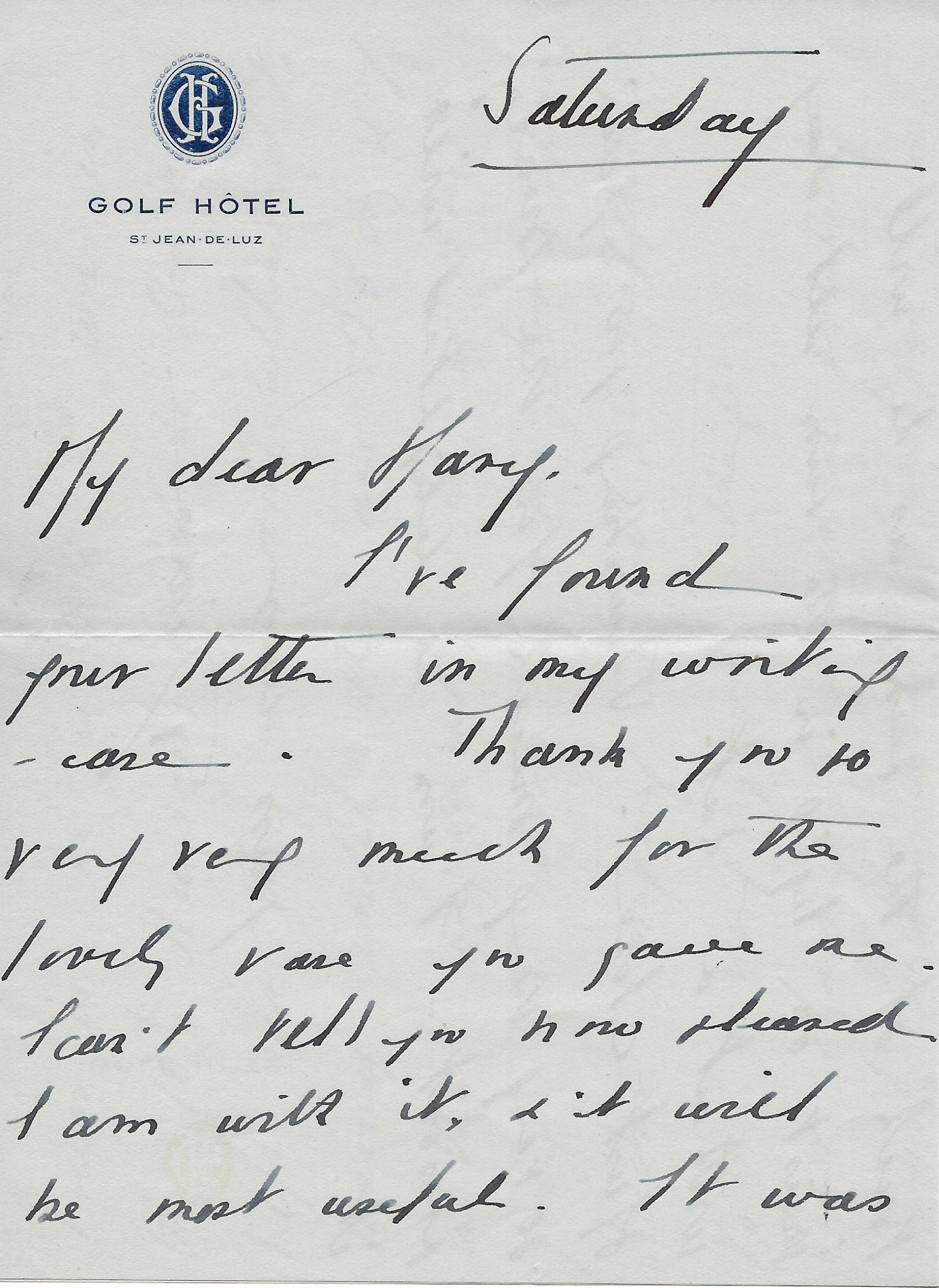
Later, looking through my mother’s papers I found a carefully preserved, hand-written letter, addressed to my mother from the Golf Hotel, St. Jean de Luz. My dear Mary, I’ve found your letter in my writing case. Thank you so very very much for the lovely vase you gave me. I can’t tell you how pleased I am with it & it will be most useful. It was so nice of you. I am so sorry I didn’t answer your letter but it was such a hectic rush these last few days. We arrived here yesterday & it is quite the most divine place. Lovely & hot and not too fasionable [sic]. We spend the whole day bathing & paddling about the sea in a canoe. Then golf in the evening. You asked me how old Trevor is, he is 22 & was in the 10th Hussars, which he has now left as they are not allowed to marry until they are 26 or 27 in that regiment & he is now going to work in the Sorbo Sponge Rubber Company which is supposed to be a very good thing. Poor darling – he is at present in bed with what I imagine is a touch of the sun as he will insist on lying in the sun all day without a hat. Must close. Thanking you again so very very much for the lovely present. I am so delighted with it. Yours ever, Diana.
The marriage did not survive; they divorced in 1938.
Either she made a mistake, or he re-joined the 10th Hussars as the records show that 2nd Lt. S.C.T. Moorhouse of the 10th Hussars was a member of the British Expeditionary Force when he was awarded a Military Cross, gazetted 27th September 1940. The citation says Second Lieutenant Moorhouse’s cruiser was hit and set on fire, though not before it had accounted for a particularly deadly 37-mm gun, and most unluckily Captain Wyndham Malet and Second Lieutenant J Rowell were killed in their tank.
After that lucky escape Trevor survived the war and lived until 1975, Diana died in 1996 and my mother outlived them both. I wish I had asked her about that wedding.
Family members and friends know that The Cobbold Family History Trust and its archive are now safely cared for at Knebworth House in Hertfordshire. Over the 500 years that Knebworth has been the home of the Lytton family it has established itself as a world leader in preservation. The Trust is truly grateful to the Knebworth trustees.
Victor, 2nd Earl of Lytton (1876-1947) #2298 on the web family tree, married PamelaChichele-Plowden (1874-1971) #2299 and they had two boys and two girls. Antony (1903-1933) #2300, the elder son died in a flying accident in 1933 and Edward (1910-1942) (known in the family as John) #2301, the younger was killed in action at El Alamein in 1942.
When the 2nd Earl died in 1947 his elder daughter, Hermione (1905-2004) #491 inherited Knebworth. I remember her well. She was the nicest, kindest, most gentle person imaginable. The connection with the Cobbold family was established when she married Cameron Cobbold (1904-1987) #490 in 1930 who became Governor of The Bank of England from 1949 to 1961, and was Lord Chamberlain from 1963 until 1971. He was ennobled as Baron Cobbold of Knebworth in 1960.
I propose two or three Cobbwebs devoted to the history of the house and its principal occupants and I make no secret of the fact that these will be abridged from an article in Country Life January 31st 1985 by Sibylla Jane Flower.
‘Today the dominating character at Knebworth is that of Edward Bulwer Lytton, the Victorian romantic novelist, but this article traces the earlier history of the house, in particular the reduction and remodelling carried out by his mother, Mrs Bulwer Lytton, in 1814-1816.
‘A large pile of bricks, with a fair quadrangle in the middle of it ”was Sir Henry Chauncy’s description of Knebworth House in the last years of the 17th century, “seated upon a dry hill in a fair large park, stocked with the best deer in the county, excellent timber, and well wooded, and from thence you may behold a most lovely prospect to the East.”
‘The park is still studded with fine trees, and deer have been reintroduced in the last 10 years, but the house has been altered out of all recognition, and the view which delighted Chauncey has Stevenage in the distance, with the land between intersected by the A1 motorway.
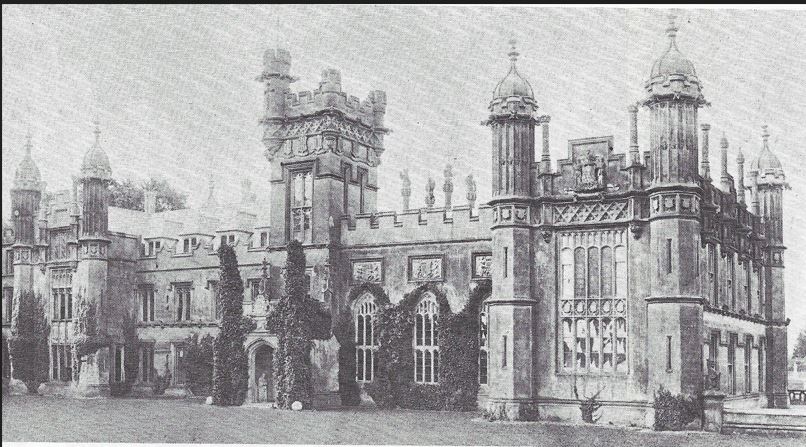
‘The building to which Chauncey refers dated from the 15th and 16th centuries, but was drastically reduced in size in the early 19th century when three sides of the courtyard were demolished, and the remaining wing fashioned into a manageable country house for MrsBulwer Lytton. [(1770-1843) #9163]
‘Her son, Edward Bulwer Lytton, [(1803-1873) #3678] disliked his mother’s mild Regency Gothic. After her death in 1843 he transformed the house into a more consciously Gothic edifice with the aid of extensive stucco decoration and the proceeds of a string of successful novels such as The Last Days of Pompeii, Rienzi and The Last of the Barons.
‘Bulwer Lytton’s taste still dominates the house, despite the efforts of his grandson, the 2nd Earl of Lytton, and his wife to dilute the pervasive atmosphere of Victorian Gothic. The efforts of the present owner, David Lytton Cobbold [(1937-2022) #625], who is a great-great-grandson of Bulwer Lytton and his wife have been directed towards the rehabilitation of Bulwer Lytton as the presiding genius at Knebworth.’
Anthony Cobbold
The south range of the courtyard in 1805.
The entrance front in about 1880 showing the full effect of Edward Bulwer Lytton’s remodelling.
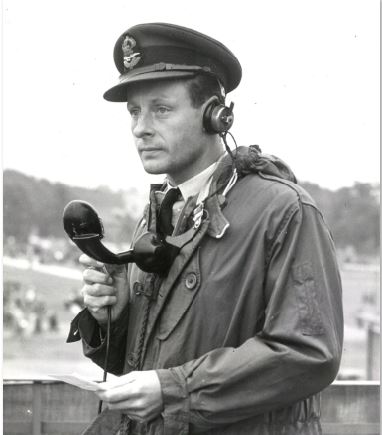
Christopher Blount on air communications as an equerry in 1954
From time to time in life one hears of truly exceptional people. Christopher Blount #626 on the web family tree was just such a person. He was born the son of an Air Vice-Marshal, a Royal Flying Corps veteran who died in a flying accident in 1940, and was educated at Elstree, Harrow and Trinity College, Cambridge. A year after her coronation he was selected as an equerry to Her Majesty Queen Elizabeth II and accompanied her on her 1956 tour of Nigeria and her state visit to Portugal a year later. In 1957 he married Susan Cobbold (1933–2021) daughter of 1st Baron Cobbold (1904-1981) #490.
During an eventful flying career he flew Mosquitos, twin-engine Brigand ground- attack aircraft for 8 Squadron in Aden and became ADC to Air Officer Commanding British Forces in Aden. After a spell at Biggin Hill where he flew Vampires, he was appointed to command 45 Squadron in action in support of Operation Firedog, the campaign against communist terrorists in the Malayan jungle. Initially they flew single-seat Venom aircraft but later were equipped with the twin-engine Canberra. In cloud, one such craft collided with the tail of Christopher’s plane making it uncontrollable. He ejected from his upside-down aircraft at only 5000 feet and his parachute was open for barely 30 seconds, but he survived. On another occasion his Canberra’s undercarriage would not lower and he was forced to make a smooth “pancake” landing.
In 1965 the family suffered further tragedy when Christopher’s elder brother, Air Commodore John Blount, DFC, a former Spitfire photographic reconnaissance pilot and PoW, then serving as Captain of the Queen’s flight, was killed when a Whirlwind helicopter crashed because of a rotor blade failure. In retirement he worked for Hambros Bank and later, Lazard. Christopher died last December aged 99. His funeral service was held in the village church of St. Mary Magdalene, Barkway which he supported vigorously. The congregation heard a recording, made last year by Christopher himself, of a poem ‘High Flight’ by John Gillespie Magee Jr.
There was not a dry eye in the house.
Oh! I have slipped the surly bonds of Earth
And danced the skies on laughter-silvered wings;
Sunward I’ve climbed, and joined the tumbling mirth
Of sun-split clouds, – and done a hundred things
You have not dreamed of – wheeled and soared and swung
High in the sunlit silence. Hov’ring there,
I’ve chased the shouting wind along, and flung
My eager craft through footless halls of air….
Up, up the long delirious, burning blue
I’ve topped the wind-swept heights with easy grace
Where never lark, or even eagle flew –
And while with silent lifting mind I’ve trod
The high untrespassed sanctity of space,
Put out my hand, and touched the face of God.
Anthony Cobbold
Christopher Blount on air communications as an equerry in 1954