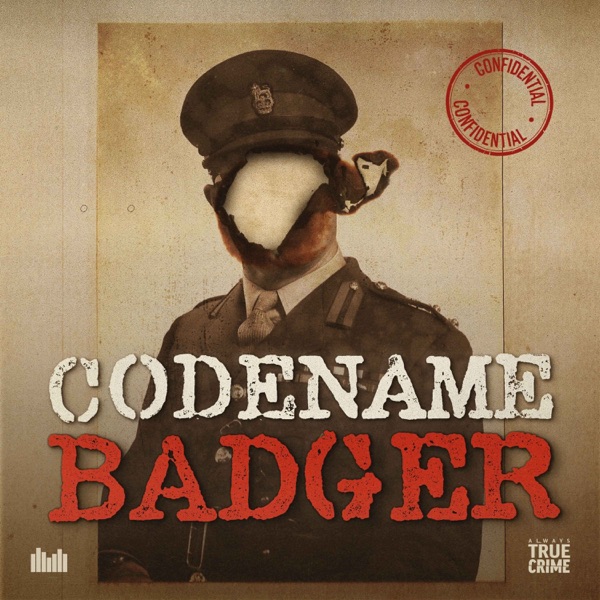
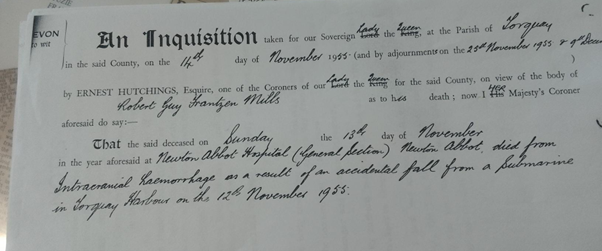
Even if podcasts are unexplored territory, to be recommended is the recently released Only True Crime podcast “Codename Badger”. Spanning seven episodes (with more in the pipeline) it tells the story of a man named John Cottell who spun a web of lies entrapping a widowed mother of four, Josephine Mills, who, believing his every word, trusted and supported him over five decades. She effectively handed over her life to a man who confided in her that he would one day have information vital to her knowing the reason for her husband, Robbie Mills’ sudden death falling from a submarine in November 1955.
Robbie and Josephine were my parents. This story has encompassed most of my life, yet has recently come to the fore with the publication of “Codename Badger” in this, my 80th year.
If you have already listened to the first episode ‘The Stranger’ you will know that early in 1956, John Cottell knocked on our front door introducing himself as my late father’s best friend. For your husband’s best friend to be unknown to you is curious, but perhaps my mother was intrigued by her visitor. He claimed to have been in the Army during WW2 alongside Robbie. He soon disclosed that he had worked for the British Secret Services as, he said, had Robbie, but it all had to be hushed up for fear of repercussions.
It was from that time on that my mother became increasingly secretive and, in parallel, more religious. As someone who rarely shared her thoughts or feelings, we, her four children, sensed it. From then on, she hinted that John Cottell, who became a regular, if unpredictable visitor, was not all he seemed. He was more than just a beach photographer, but his other work was to be kept secret. The message we picked up from her was that she wouldn’t say, so we mustn’t ask.
Such was the atmosphere in our home though perhaps at some stage she implied that John held secrets to do with our father’s death; another topic not openly shared. Until, as part of my enquiries into my father’s life, I read the Inquest Report, in 2003 I had had no idea alcohol had been part of the story of his fall. We knew he liked to drink pink gin – there were Angostura bitters in the drinks cupboard.
Over the next decades John continued to feature in our lives; he would often turn up at our home in Devon, then after 1959, in Hampshire, with his stories. One time he told my mother he had killed someone with a poisoned umbrella (viz Georgi Markov assassination in 1978) but had not been charged, to which my mother muttered “he must hold a very high up position” (implying, in the Intelligence Service, to get away with it). His stories were pretty far-fetched with never any evidence to substantiate them.
At his suggestion. during a holiday together in Florida in 1985, in 1987 my mother retired to live in Andorra to be with John. Then, like her, we waited, but on the side lines, for him to join her. He would make short visits from America, accepting sums of money from her that he claimed he needed for a case at the Court of Human Rights in Strasbourg with the promise of untold wealth when his case was proven. Over the next 13 years my sister, brother and I visited her regularly for skiing and summer holidays. As we know from family photographs and mentions in my mother’s diaries, John was sometimes there too for a visit of perhaps two or three weeks. However, he told her he was unable to be with her permanently as he was still working for the secret services and to marry would need permission from his commanding officer.
From the start, as a recently bereaved child of 9, I had disliked John Cottell, but after so many years I tolerated him for my mother’s sake. Even when serious enquiries in Parliament failed to confirm John’s stories of being in the Army and SOE, she remained closed to any suggestions he was not all he said he was, convinced that God was asking her to protect him. We were very sceptical but she remained secretive and was not open to discussion. We knew how much she wanted to be with him, so felt she should be free to live her life as she chose.
After 13 years living alone 6 km up a mountain in Andorra, John suggested that, to meet their health needs, they would both be better off living in France, as he had convinced her he was suffering from Multiple Sclerosis, amongst other serious medical conditions. Longing to be married to John and living together, she agreed to a move.
Spending Christmas 2000 with her in a gite John had found near Quillan in the Aude district of France, we realised she was no longer safe living on her own. We decided we must take over her care; telling her of our decision she replied, “I’ll believe it when I see it”. She didn’t believe us, whereas John, who seemed blind to her increasing everyday needs, she believed implicitly.
In 2003, with my mother in decline mentally, I decided I would find out once and for all the truth about my father’s military life and his death. I felt I needed to know what had really happened. Had he been in SOE operating clandestinely, had he worked for the SIS, had he known John Cottell?
I requested my father’s military record and was sent a lost copy of his Record of Service. The replacement copy, found among his papers, had been purloined by John Cottell (a man who declared in 1950 he had never been in the Army) who had signed, given a false date of birth, and promoted himself to Lt Colonel! In his portrait photograph that my mother displayed proudly in her home in Andorra, he was wearing a series of medal ribbons that I later found out he could never have been awarded.
Lecturing in America, where John had moved with his wife and son in the 1970s, he fascinated lunch club audiences with tales of his WW2 and Cold War activities. His colourful past in the SOE, as a prisoner in Lubyanka prison and as a vengeful husband of a Belgian fellow spy kept his audiences entertained and his coffers well supplied. However, in 1985 his cover was blown. Questioning the validity of his claims, The Sunday Times published a damning article.
John dismissed this to my mother as a plot against him and maintained his version of the truth to her, inviting her to join him in Florida for a holiday. Secretive as ever, she didn’t mention this visit to her family, however she did keep a photo album of their time together. She has the look of a young woman in love in the pictures she brought back. For his own reasons, John recorded a tape during their time there in which he mentioned the tough time my father had before he was killed. After a gap of about ten years when my mother had hardly had contact with him, John was now back on the old tack of being able to get, as yet undisclosed, information as to Robbie’s life and death. Having initially sown the seed of doubt as to the reason for my father’s death, he had my mother entirely focused on her quest for the truth.
As a keeper of everything (perhaps through not having the courage to decide what to part with), my mother surrounded herself with clutter. Included were her pocket diaries, the books and tapes John sent her, notes he asked her to make for the book he was hoping to publish, family documents and photographs, her (and our) school reports, bank statements, all her clothes (from her honeymoon on), handbags etc. All to be sorted through when she could no longer register any of it.
For the making of the podcast the tapes and diaries were invaluable. What was missing was my mother’s correspondence with John, which she burnt or tore up at his request. However, some drafts of letters were kept, helpfully giving an insight into her thinking over the years. That she felt under pressure to remain silent comes over clearly “…or I would be in a lot of trouble”. Keeping quiet, she once explained, was better than leaving the four of us as orphans, if she were to be found ‘dead in a ditch’. John clearly had her under his thumb from the start.
John was a creature of disguise and a convincing actor. Was he really an Army Colonel, or an Episcopalian priest, or a French Duke? Was he a Romanov? Did he marry a Belgian spy and have a son who died in his twenties of meningitis or leukaemia or in a traffic accident?
To discover more listen to “Codename Badger” under the umbrella of Only True Crime, available on Spotify, or wherever you get your podcasts.
Nicky Hibbin
May 2026