This piece was written in April 2026 by Anthony Cobbold for the curators of the exhibition The Moon: Meet Our Nearest Neighbour, which is on at The Hold, Ipswich from Friday 26th June to Saturday 19th September 2026.
A Suffolk-born professor, largely unknown to the general public, who has a lunar crater named after him.
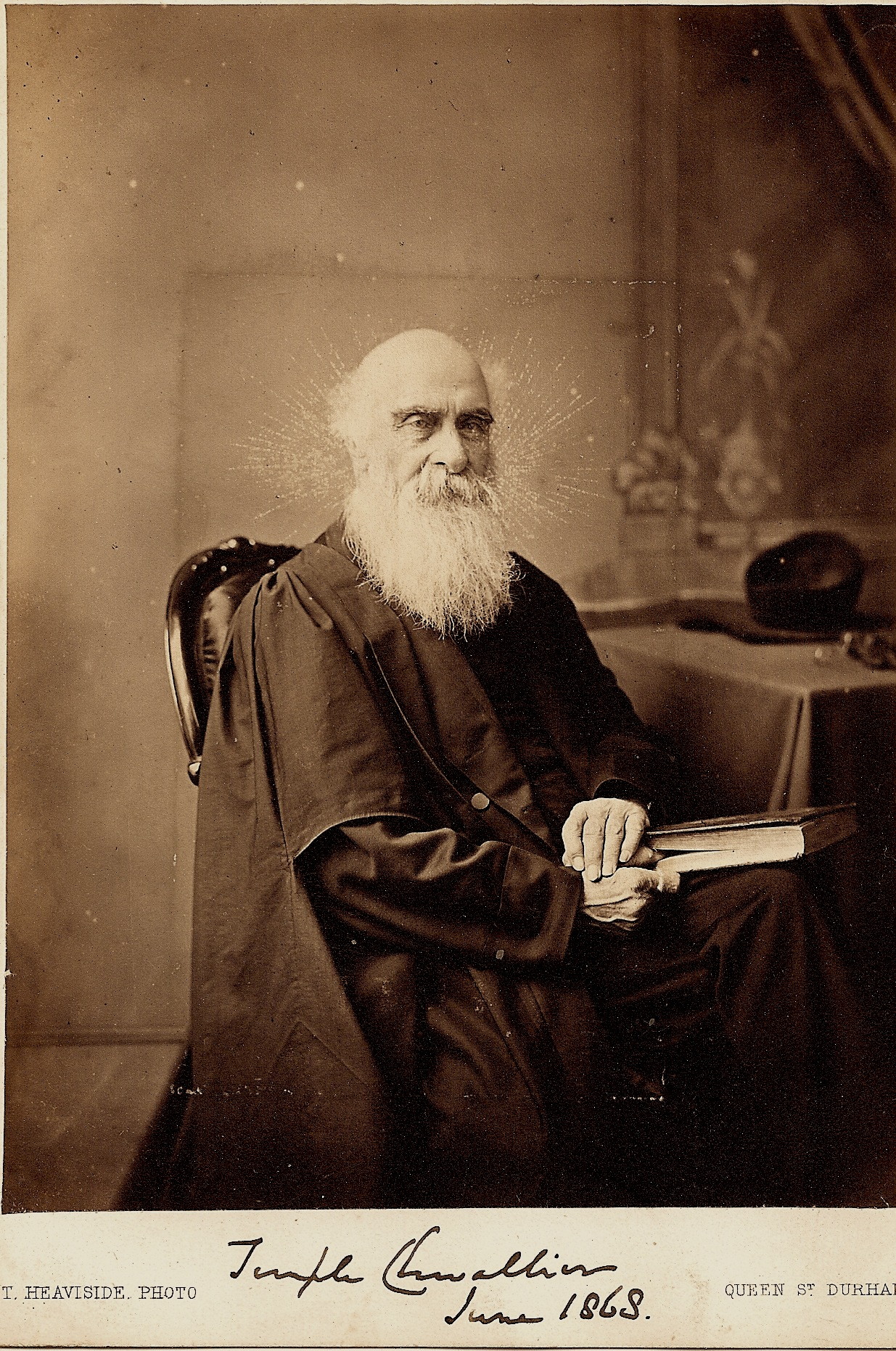
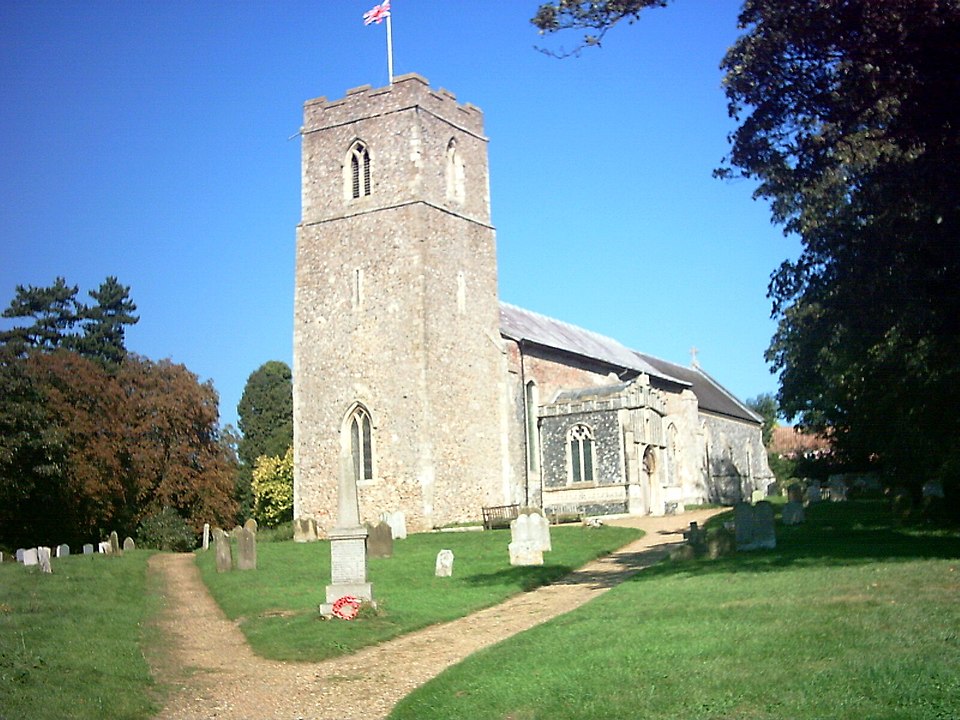
Temple Chevallier was born on 19th October 1794, a twin, in Badingham, Suffolk, to Rev Temple Chevallier (1764–1816), rector of St John the Baptist, and Sarah Edgcumbe (1766–1818). The younger Temple was educated in Bury St Edmunds and Ipswich, before going up to Pembroke College, Cambridge, in 1813. He was awarded a prestigious Bell scholarship, and graduated in 1817 as second wrangler – essentially the second-best mathematician in the university. His meteoric rise up the academic hierarchy was heralded by fellowships at Pembroke and St Catharine’s colleges.
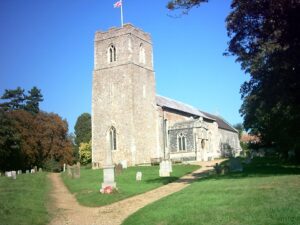
In 1818, after being ordained by the Bishop of Ely, he was appointed curate, and later vicar, of St Andrew the Great, the church of the city of Cambridge (the university church is St Mary the Great). He proceeded to MA in 1820 and BD (bachelor of divinity) in 1825. He was twice invited to give the Hulsean lecture, which explored the overlap between theology and astronomy. Chevallier would inhabit this intellectual territory for the rest of his life – and he lends his name to an occasional lecture series still held at Durham University, which delves into those twin spheres. The second of his Hulsean lectures was published as Of the Proofs of Divine Power and Wisdom: Derived from the Study of Astronomy.
Chevallier (whose name is well known in Suffolk for his family’s organic cyder business) was a cleric, classicist, mathematician and lecturer of great ability. During his final years at Cambridge, he was moderator in the mathematical tripos and an examiner in the classical tripos; he also taught Hebrew.
Whilst in Cambridge he married Catherine Wheelwright (1794–1858), whose grandfather Nathaniel Wheelwright had run up debts of £154,000 – almost destroying the entire financial structure of Massachusetts. Temple and Catherine had two daughters (Catherine and Alicia) and a son, also called Temple, who died young.
In 1835 he became professor of mathematics and astronomy at the newly founded University of Durham. It seems to have been a time of ‘all hands to the pump’, because he was additionally registrar, reader in Hebrew and lecturer in divinity. He also served as perpetual parish priest at Esh, a village just outside Durham, where he restored the church and founded the village school.
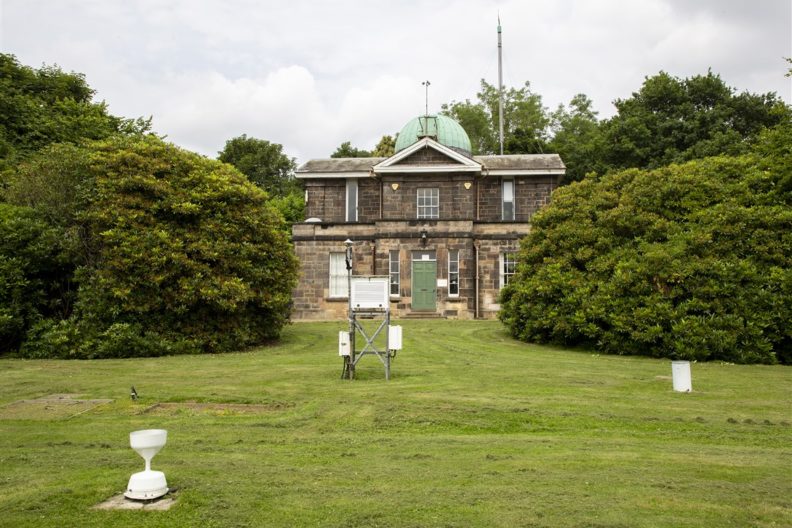
Looking back at Chevallier’s career, it is hard to avoid the conclusion that, despite the extraordinary range of his academic achievement, astronomy was his first love. On arrival in Durham, he immediately set about raising funds for the construction of an observatory and the provision of its telescope. The building, now Grade II listed, was designed by Anthony Salvin and the early instruments were donated by public subscription and local clergy.

Chevallier published in the journals of the Royal Astronomical Society some thirteen papers, including: Observations on the Planet Neptune; Observations on the Planets Flora, Isis and Neptune; Diameters of the Sun; and On a method of finding the Effect of Parallax at different places, upon the time of disappearance and reappearance of a Star occulted by the Moon.
He was elected a fellow of the Royal Astronomical Society on 13th December 1839, but continued with his quest to introduce scientific studies into education. In 1837 he helped set up the first ever course in civil engineering and mining, with the first students arriving the following year. Sadly, it did not prove a success, and the course was abandoned a few years later. In 1871 Chevallier was instrumental in establishing the College of Physical Science, located in Newcastle but largely supported from Durham – and this did prove successful. However, his health was declining, and he was forced to resign his professorship and other appointments.
He was staying with his daughter Alicia and son-in-law Rev R. J. Knight at the Vicarage, Harrow Weald when, on 4th November 1873 he died, having just entered his eightieth year. He was buried beside his church in Esh, and lies close to his wife, sister and son.

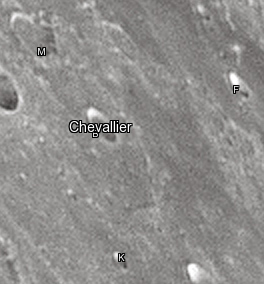
In 1935, a lunar crater was named after Chevallier in recognition of his selfless contribution to astronomy at the University of Durham. He had enhanced astronomical teaching and research, and was largely responsible for the funding of the famous observatory. The name was adopted by the International Astronomical Union (IAU) as part of its inaugural standardisation nomenclature during the union’s sixth general assembly in Cambridge, Massachusetts.
Chevallier is a lunar impact crater around 52km in diameter, situated on the moon’s near side in the northeastern quadrant. It has four satellite craters: Chevallier B (13km diameter); Chevallier F (9km); Chevallier K (6km) and Chevallier M (16km).
But that is not his only legacy.
In 2020, the Rev Professor David Wilkinson of the Department of Theology and Religion led a seminar celebrating the major milestone of 1,300 years of theological study and tradition at Durham University. This included an account of the long and rewarding life of Temple Chevallier, whose work, Wilkinson said, had helped lay the foundations for an explosion of interest in astronomy in the 20th century. Among those inspired was Stephen Hawking, with his ground-breaking research on black holes and the Big Bang, as well as recent work in Durham on both cosmology and theology.
Professor Martin Ward, a renowned observational astrophysicist, occupies the Temple Chevallier Chair of Astronomy at Durham – and in 2023 he gave the latest in the occasional series of public Temple Chevallier lectures, entitled The End is Not Yet Nigh: The Ultimate Fate of the Universe. In the audience was Hugh Chevallier, a first cousin (four times removed) of the great man.
The Durham observatory began keeping meteorological – as well as astronomical – information in 1841, but the earliest records have not survived. The first readings which we still have were taken at 9am on 23rd July 1843, and figures were manually entered until October 1999, when the Met Office automatic weather station took over. Durham’s meteorological record is the third-longest continuous series in the United Kingdom; only records from the Radcliffe Observatory in Oxford (dating from 1772) and Armagh Observatory (1795) stretch back beyond 1843.
Data from sites such as Durham are of enormous value – never more than now, – in analysing and understanding changes in climate, but it was the ‘outstanding universal value’ of Durham, its cathedral, castle and university that prompted UNESCO to declare the city a World Heritage Site in 1986. It has been a centre of religion, education and pilgrimage for over 1,000 years.

Little did Suffolk-born Temple Chevallier imagine that his 38 years in Durham would have so profound a legacy, or that in 2026 his importance in the history of scientific and religious study would be so firmly established.
Anthony Cobbold
Trustee, The Cobbold Family History Trust.
April 2026