Here we record the early days of ITFC, those days when the Cobbold family’s influence was greatest. For more recent history of the Club and for current news please use the links provided at the end of our account.
(Numbers following # indicate position on family tree)
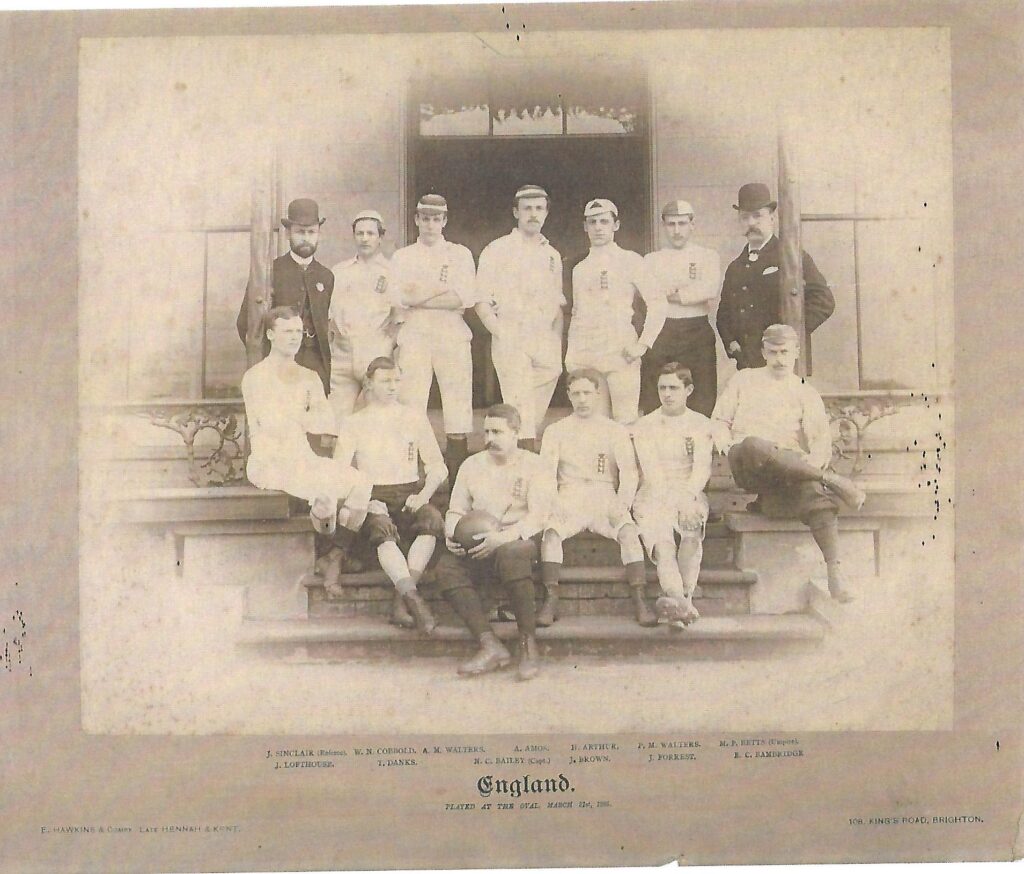
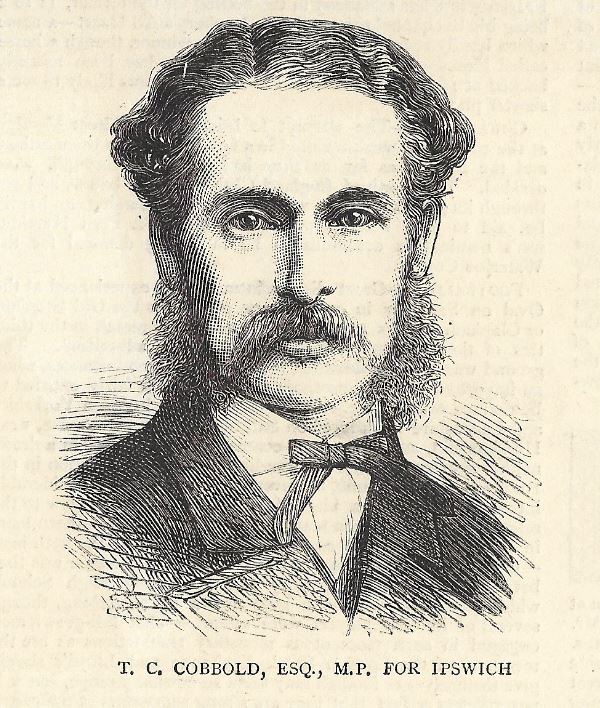
The amateur club in Ipswich was founded on 16th October 1878 at a meeting in the new Town Hall, it having been opened only 10 years previously during the mayoralty of John Patteson Cobbold (1831-1875) #186. The club was promoted mainly by old boys of Ipswich School which had been playing football to Association rules since 1874. Thomas Clement Cobbold (1833- 1883) #191 who was the MP for Ipswich at the time was elected president. He too had been a scholar at Ipswich School and had played football at Charterhouse.
Charterhouse was one of the most influential schools in early association football because when the game started in long thin cloisters dribbling and kicking were encouraged. It was a founder member of the FA in 1863 and its former pupils helped write the Laws of the Game.
The first match at the new club was The Secretary’s Team v The Club. Thomas Clement presented a new ball, kicked off and is reported to have “played with great spirit and entered into the game most thoroughly.” The result was a 2 all draw.
The Cobbold family involvement continued when in September 1885 Thomas Clement’s brother, Nathanael Fromanteel Cobbold (1839-1886) #195 was elected a vice president (already being Treasurer of the newly formed Suffolk County FA) but sadly his tenure was short as he died suddenly and unexpectedly in February the following year. Almost immediately his nephew John Dupuis Cobbold (1861-1929) #307 was chosen to replace him.
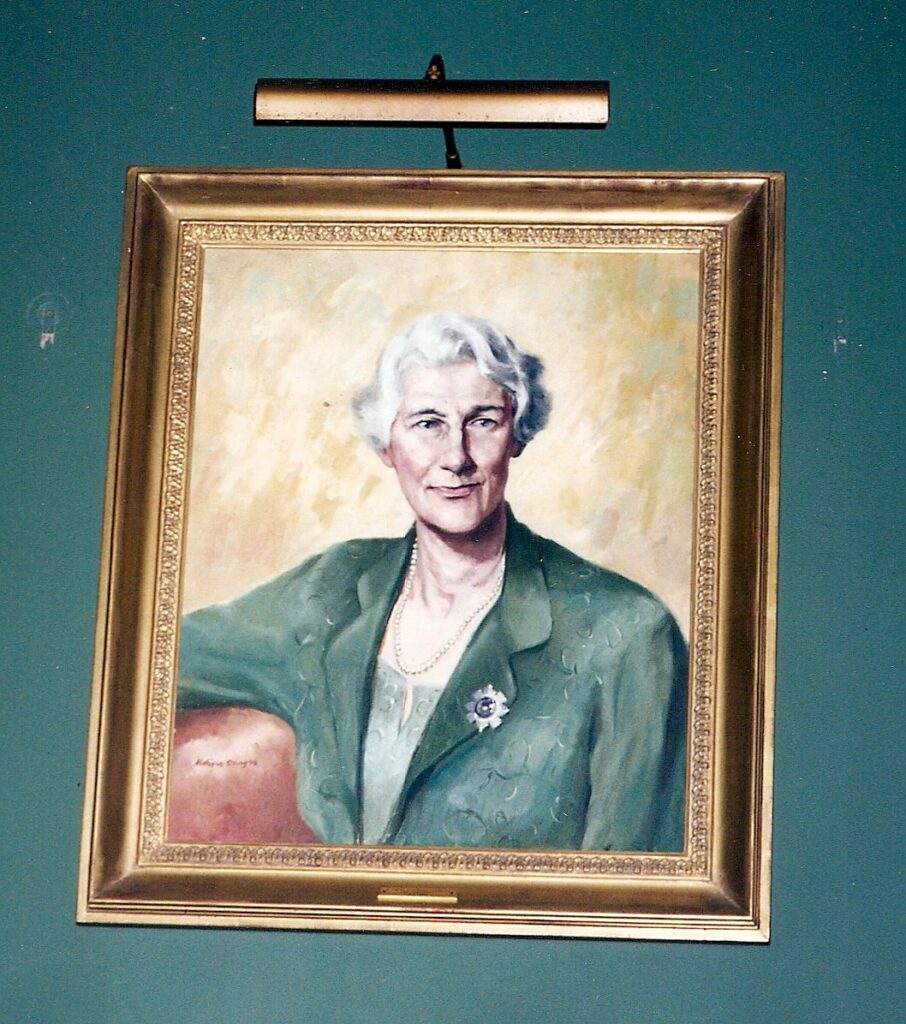
However, Herbert Jervis-White-Jervis died in 1934 having served the club as president for 20 years. His successor in 1935 was John Murray Cobbold (1897-1944) #448, son of John Dupuis, and known affectionately as Captain Ivan. Story has it that he vexed his parents so greatly as a child that he was nick-named ‘Ivan the Terrible’ and it stuck! In 1919 he married Lady Blanche Katherine Cavendish (1898-1987) #449 daughter of the ninth Duke of Devonshire and they moved to Glemham Hall. Holywells, the former Cobbold home was sold to Lord Woodbridge following John Dupuis’ death in 1929. Lord Woodbridge donated it to the people of Ipswich.
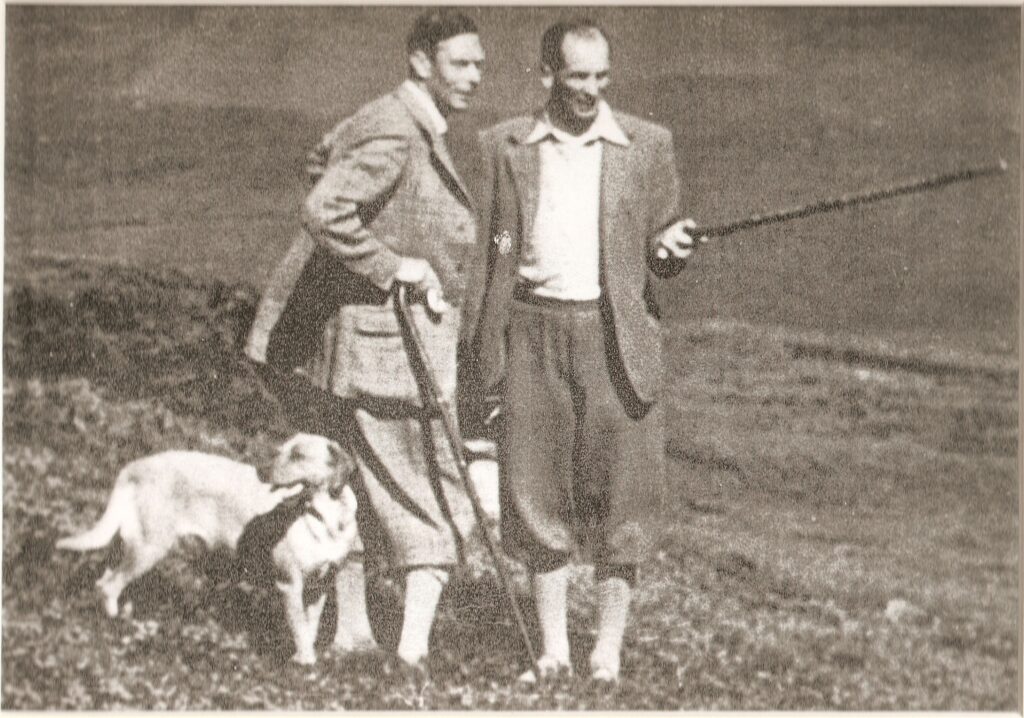
Captain Ivan was a dedicated sportsman (a regular at King George VI’s shooting parties at Sandringham) and was due to go racing one day with Sir Samuel Hill-Wood, the Chairman of Arsenal but it was rained off so they went to Highbury instead. Captain Ivan was so impressed that he determined that Ipswich Town should turn professional and it did in 1936.
Captain Ivan was Chairman and Robert Nevill Cobbold (1904-1944) #470 son of Philip Wyndham was a director. There were some early financial problems which seem to have been eased by directors’ contributions.
Mr. A. Scott Duncan replaced Mick O’Brien as Manager on 12th November 1937. Town had applied to join the league but Captain Ivan doubted that they would succeed at the first attempt but Scott Duncan felt differently. They had a little bet. Scott Duncan had done a lot to promote his new club’s cause so when Town was elected by a margin of just 2 votes the wager was settled with great speed and gratitude.
War intervened; play was suspended and Captain Ivan became Lt. Col. Ivan (though he continued to be known by his former rank) and Mr. Robert became Maj. Robert. The board met in 1943 and plans were in place for play to resume as soon as hostilities ceased but the following year tragedy struck. Maj. Robert was killed at Monte Piccolo in Italy whilst serving with the Welsh Guards in May, and Captain Ivan died in the Guards Chapel during Sunday morning service when it was hit by a flying bomb on 18th June.
Play was resumed with restrictions in 1945 but the club and the family suffered another blow at Christmas with the death of Philip Wyndham who despite poor health had been holding affairs together during the war. His son, Lt. Cdr. Alistair Philip Cobbold (1907-1971) #472, Maj. Robert’s brother, was co-opted to fill his father’s vacancy. Next year the club revealed that it was £6000 in the red! This increasingly familiar problem was quickly solved by an interest free loan from Cobbold & Co. Ltd.
The more recent story is better known. Captain Ivan’s son John Cavendish Cobbold (1927-1983) #575 was appointed a director in November 1948 at the age of only 21 and was believed to be the youngest football director in the country. The following year his cousin Alistair Philip became Chairman. In 1955 Alf (later Sir Alf) Ramsey succeeded Scott Duncan giving rise to Billy Wright’s shrewd comment ‘In appointing Alf to become their manager Ipswich Town paid a tremendous tribute to intelligent football – and footballers who think!’ At the end of the1956/57 season Mr. John (as he was known to almost everybody) though still only 29 took over from his cousin as Chairman.
The very considerable successes achieved by the club within just 25 years of its turning professional are more skilfully recorded elsewhere but the Cobbold family can probably justifiably claim to have endowed the club with much of its Corinthian culture. Many seasons were completed without a single player being booked and in 1959 the writer of the Bristol Rovers programme enthused ‘Ipswich are now regarded as one of the most sporting and attractive teams in the Second Division, which is not surprising when one thinks of members of the Cobbold family being on the board and Alf Ramsey being manager’. Later Matt Busby described Town as ‘one of the First Division’s most attractive sides’ when it won the Division but lost Alf to the England job.
Mr. John’s brother, Patrick Mark Cobbold (1934-1994) #576 joined the board in 1964 and their mother Lady Blanche (1898-1987) #449 became honorary president. 1966 saw England win the World Cup and Mr. John was one of the first to congratulate Sir Alf. Bobby (later Sir Bobby) Robson was appointed in 1969 and started to build the foundations for the substantial successes which were to follow. Sadly, Alistair Philip died in November 1971 having been Chairman for 8 years (1949-1957) and a director for 25 years (1946-1971).
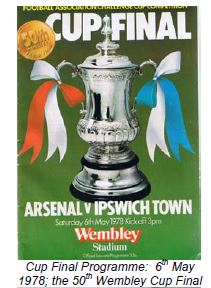

Due to the onset of cancer Mr. John became less able to carry out his chairman’s duties so he and Mr. Patrick swapped places in 1976. Town’s finest hour was approaching. The team reached the UEFA Cup semi-finals in 1977; won the FA Cup in 1978 and the UEFA Cup in 1981, a memorable performance for a sparsely populated county like Suffolk.
Mr. John finally succumbed to his cancer after a brave struggle in September 1983 at the age of only 56. He was probably the best known of all the board members and was admired here and in Europe for his honesty, integrity, and hospitality. His sparkling wit and sense of style made him immensely popular. Fittingly his place on the board went to John Kerridge, Chairman of Fisons, a governor, and former pupil of Ipswich School where it all started 106 years before.
Mr. Patrick stayed at the helm for another 8 years before handing over to John Kerr in 1991. Patrick died suddenly and unexpectedly in 1994 after 27 years of service which included Town’s FA and UEFA Cup victories. Even then the Cobbold connection did not perish. In 1995 Mr. John and Mr. Patrick’s nephew, Major Philip William Hope-Cobbold (1943-2020) #577 joined the board and continues the dynasty.
In the first 71 years since ITFC went professional there have been 35 directors and one fifth of them have been Cobbolds. During that period there have only been 8 Chairmen and 5 of them have been Cobbolds. Their spirit and their values have played a remarkable part. Perhaps it is best illustrated by Sir Bobby Robson’s tribute to Mr. John. ‘When we won John Cobbold had a bottle of Champagne and when we lost, he had two bottles of Champagne. That was his civilized way of looking at defeat. He was a remarkable guy, an outstanding fellow.’