The Graves-Sawle family appears on the Cobbold family tree because of the marriage of Col. Ralph Patteson Cobbold (1869-1965) #316 to Rosemary Graves-Sawle (1890-1971) #319, daughter of Rear-Admiral Sir Charles John Graves-Sawle MVO 4th Bt. (1851-1932) #2535.
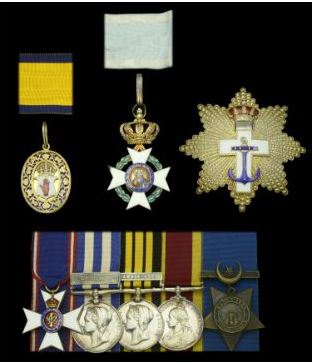
A group of the Rear-Admiral’s awards came up for auction recently but, with a guide price around £4000, it was well beyond our means. The collection comprised his Baronet’s Badge, his MVO (Member of the Victorian Order) and eight medals awarded during his distinguished naval career.
His obituary in The Times tells us:
He entered the Royal Navy in March 1865. He served in the Hercules and Bellerophon and was promoted to Lieutenant in April 1876. He went to the Mediterranean in October 1880 as Lieutenant of the Superb and served there about six years. He was present at the bombardment of Alexandria in July 1882 and during the operations of the Egyptian War, for which he received the Medal with clasp ‘Alexandria 11th July’ and the Khedive’s Bronze Star.
In 1888 he became Second in Command of the Canada on the North American Station. He was appointed in January 1890 as First Lieutenant of the battleship Anson, Flagship of Rear-Admiral Tracey in the Channel Squadron and was promoted to Commander in 1890.
The following summer he went to the Cape as Commander of Raleigh, Flagship of the Commander in Chief Rear Admiral Sir Frederick Bedford KCB. [Admiral Sir Frederick George Denham Bedford GCB GCVO (1838-1913) – later Governor of Western Australia – also appears on the Cobbold family tree married to Ethel Turner (1856-1932) #15236, daughter of Edward Rush Turner (1823-1904) #15210 of Ipswich, a pioneering agricultural engineer whose company, E R & F Turner achieved international fame.] It fell to the Rear-Admiral to conduct certain punitive expeditions in West Africa in one of which Commander Graves-Sawle took a prominent part.
After Flag Captain Gamble had been wounded, he took command of the Naval Brigade landed from Raleigh, Alecto, Satellite, Magpie and Widgeon at Bathurst, on the River Gambia, in February 1894, in co-operation with two companies of the West India Regiment, to punish a rebellious slave trading chief named Fodi Silah. For his services he was Mentioned in Despatches and received the General Africa Medal with clasp ‘Gambia 1894’.
In the following August he received his first independent command, the light cruiser Mohawk, in North American waters and in December 1896 he was promoted Captain. His first service as Captain was as Flag Captain to Vice-Admiral Sir Frederick Bedford [with whom he had served previously] in Crescent, on the North American Station. In 1900 he went to China as Captain of the Bonaventure. As Captain of the cruiser Aboukir in the Mediterranean on the occasion of King Edward’s visit to Malta in 1903 he was made MVO. Following his father’s death in April 1903, and the death of his brother without issue in August of the same year, he succeeded to the Baronetcy and property. He did not seek another appointment and retired. He was ADC to King Edward VII in 1906 and was advanced to Rear-Admiral on the Retired List in 1907. He became High Sheriff of Cornwall in 1913.
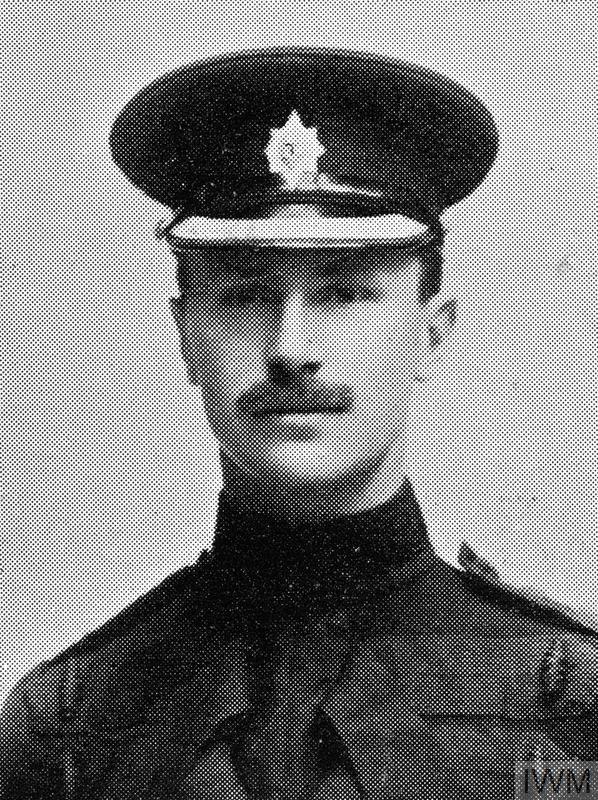
His son, Lieutenant Richard Charles Graves-Sawle (1888-1914) #8052 who served with the Coldstream Guards at Ypres was killed by a sniper in November 1914. He died without male issue which means that the Baronetcy became extinct. However, Richard’s image was chosen by Danny Boyle (of 2012 Olympic Games opening ceremony fame) to be one of 28 Heroes’ faces etched in the sand around the UK as an Armistice Centenary tribute. Richard was portrayed on Porthcurno Beach in his native Cornwall.
Anthony Cobbold