A call after I had gone to bed one night (because she works shifts) introduced me to one Lisa Barrett. She called enthusiastically hoping I might help by joining the many objectors to a proposed development in Yardley, Birmingham. Why me, I hear you ask? Lisa had discovered that a house threatened by the development was thought once to have been the home of James William Turner (1842-1913) #2952 on the web family tree. The development was close to Lisa’s home and also threatened some playing fields and other amenity land highly valued by the local community. The call prompted me to look more closely at the life of James William Turner, to which Lisa subscribed her findings.
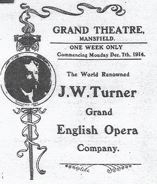
James was a famous 19th century tenor opera singer who literally sung his way around the world and later formed his own opera company and became a theatre owner in Birmingham; but what of his parents and siblings? His father John Turner (1810-1886) #6411 was a hosier by trade but also one of 4 members of a successful group of glee singers in Sutton in Ashfield in Nottinghamshire. John married Elizabeth Brookes (1807-1869) in 1832. All 4 members of the glee group were, unusually, born in 1810; they got together when they were still in their teens and performed with an unrivalled reputation for over 30 years. John was their Bass. A glee group exists to this day being known as “The Portland Glee Party.”
Of all Sutton’s musical talent none has surpassed that of John’s son James who was born on High Pavement the eldest of 4 children, a brother Charles and 2 sisters. Charles (1845-1894) #7020 also possessed a fine voice (he was known as the Silver Tenor) and formed his own company called the Montague Turner Opera Company which performed mainly in Australia and New Zealand. His second wife’s maiden name was Mary Montague Cooke whose family came from Honolulu in USA. Mary was herself an accomplished prima donna. James’ sisters actually thought Charles had the better voice but that in no way impeded James’ rise to fame.
At the age of just 20 he was with Harry Templeton’s African Opera Troupe and the following year. he joined a concert party which toured India, the Far East and Melbourne, Australia. At the end of that year he made his operatic debut as Elvino in Sonnambula at the Haymarket Theatre, Melbourne. After a spell of advanced tuition at the London Academy of Music he became a great favourite in London music halls from where he was recruited by the Carl Rosa Opera Company. In 12 years he accumulated over 500 performances in 22 operas. In 1871 he had married Emma Cowpe-Pendleton (1850-1918), a union which yielded 2 boys and 3 girls.
He left Carl Rosa in1883, though did a couple of seasons for them at the Theatre Royal, Drury Lane, London before forming the Turner Opera Company in 1886 when he became both tenor and impresario which he would remain successfully for many years. Other Rosa singers followed but James was the first to take on not only a management role but that of the theatre owner as well. He acquired the Grand Theatre in Birmingham which was designed by Birmingham architect W H Ward and which opened on 14th November 1883 though it was probably called the New Theatre at the time. It had seating for 2200 and ran successfully until James sold it to Moss Empires in 1907.
In his earlier days he was no mean cricketer, once turning down the offer of a professional engagement. It is said that at Clay Cross he bowled out all 10 wickets and one Whitsuntide he played through a snowstorm.
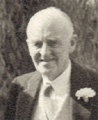
James educated his son, James William Cecil Turner (1886-1968) #1160, the youngest by 8 years of his 5 children, at King Edward’s School, Birmingham where he was a scholar and this may have accounted for his move to Yardley in Birmingham. Young James was called up in 1915 and undertook gunnery training in Totnes where he met his future wife, though they were not to marry for a further 9 years, and the following year found him a subaltern in the Royal Field Artillery in France. In common with many of his generation he never talked about his wartime experiences and certainly not about the award of his Military Cross, which out of disdain for the whole concept of war he never collected. It was many years later that the citation was discovered. It read that “he, having withdrawn his battery under heavy fire returned under continuing fire and rescued his wounded Battery Sergeant whom they had been forced to abandon.”
After the war he returned to Cambridge where he became a distinguished writer in Roman and criminal law and a fellow and bursar of Trinity Hall. In addition to editing numerous volumes of Kenny on Criminal Law and Russell on Crime he made an immeasurable contribution to the Institute of Criminology.
Back in Yardley James senior lived at The Croft on Barrows Lane, later known as The Poplars, which sadly is reported to have been demolished by 1938. This dispels the anxiety that James’ home is threatened by the proposed development but no doubt the loss of playing fields in green open spaces remains an acute and understandable concern for the community.