SIR ERNEST SHACKLETON 1874-1922 November 2022
Jonathan Shackleton #1541 has been a keen supporter of our Trust for many years. 2022 marks the centenary of the death of Jonathan’s more famous cousin, Sir Ernest so it seems appropriate to recall the extraordinary deeds that have made his name almost a household word.
Ernest Henry Shackleton was born on the 15th February in 1874 in Kilkea House, County Kildare in Ireland. The second in a family of ten, his father Henry was a farmer. His mother Henrietta was descended from the Fitzmaurices, a family which had been in Kerry since the Norman times in the 13th century. Abraham Shackleton was a Quaker from west Yorkshire who came to Ballitore in County Kildare and started a school in 1726.
In 1880 when Ernest was six his father gave up farming and went to Trinity College Dublin, and qualified to be a doctor. The family lived at 35 Marlborough Road in Dublin and in 1884 they moved to Sydenham in South London where Henry practiced for 30 years.
After attending school at Dulwich College as a day boy Ernest, aged 16, joined the Merchant Navy. After 10 years he gave that up and joined a British Expedition led by Captain Robert Falcon Scott (1868-1912) to try and be the first to reach the South Pole. In the summer of 1901 the ship, The Discovery departed for the Antarctic.
On 30th December 1902 Scott, Shackleton and Wilson reached within 400 miles of the South Pole, the furthest South yet achieved by anybody. Shackleton was invalided on the return journey and was sent home early. His experience on this expedition then spurred Shackleton on, to have a go at reaching the South Pole himself. In 1904 after his return, he married Emily Dorman, they had three children Raymond, Cecily and Edward.
In March 1907 Shackleton outlined his own trip, which he organised himself with the minimum of official support. The Expedition was to leave New Zealand in 1908. The ship chosen Nimrod was a sealing ship which generally worked from Newfoundland. It was brought down and arrived in London in mid-June 1907. The Queen presented Shackleton with a Union Jack to carry on the sledge journey. They ship left for New Zealand on the 7th of August.
The Commonwealth Government gave Shackleton £5000 and the New Zealand Government gave him £1000 and agreed to pay for half of the cost of towing the ship down to the Antarctic Circle to save coal for the journey that lay ahead. They entered the Ross Sea on January 16th. On the 28th of January the ship froze in the ice.
The next day they lowered their motorcar onto the ice pack, the first automobile on the Antarctic Continent. The team set up the hut they had brought with them and the men crammed in. The weather began to close in and the sun to set. On the 29th of October 1908 Shackleton, Adams, Marshall and Wild headed for the South Pole, a 1700-mile round trip. The other men had set up many depots for the journey using the motorcar for several of them. The team began to run low on rations and shot the ponies for food. On the 9th of January 1909 they reached a new furthest south – just 97 miles from the South Pole. They had to turn around due to lack of food.
After the Norwegian Amundsen (December 1911) and Scott (January 1912) had reached the South Pole, Shackleton thought up and attempted to carry out another great plan – to cross the 2000-mile Antarctic continent.
This trip was a very successful failure.
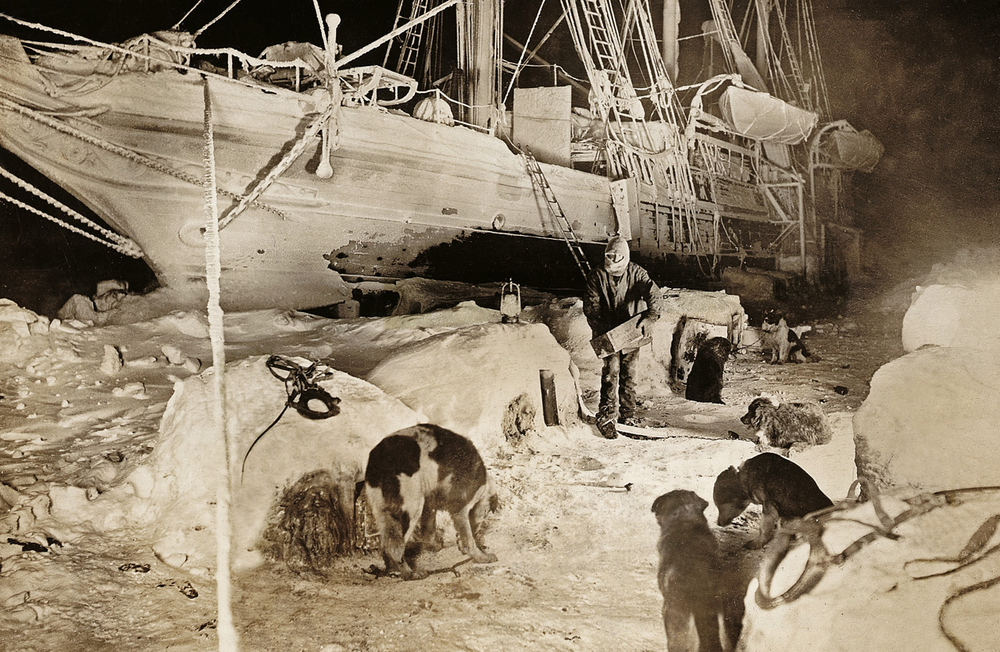
The team of 28 men and 68 dogs never set foot on the continent (the husky dogs had come from Gimli near Winnipeg, crated in cattle cars to Montreal and shipped in the cattle boat ‘Montcalm’ to England).
Shackleton’s ship the “Endurance”(named after the family motto “By Endurance we conquer”) was trapped in the ice in the Weddell Sea for 11 months, from January 1915 until it was squashed and sank in November 1915, leaving 28 men on the ice with 3 small ship’s boats. They then spent 5 (admittedly summer) months on an iceberg floating away from the continent. With great good fortune they landed on Elephant Island on the 15th of April 1916. It is a small godforsaken island of rock and ice with a few penguins and seals for food.
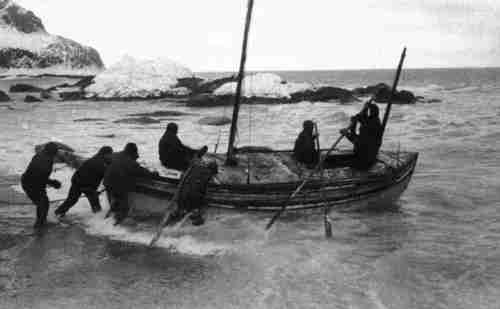
So, there they were in April 1916, lost to the civilised world, and heading into an Antarctic winter. Losing no time Shackleton’s next move was to be one of the greatest small boat journeys ever made. Shackleton and 5 others set off in the 22-foot boat the “James Caird” on an 800-mile journey across one of the roughest seas in the world to the island of South Georgia to get help.
Two other members of the crew were from Ireland – Tom Crean from Annascaul in County Kerry and Tim McCarthy from County Cork. Tom Crean was one of the great crew members of the heroic age of Antarctic exploration. He was strong, courageous and good humoured and experienced – he had already been on two of Scott’s expeditions – and was awarded the Albert Medal for bravery. Frank Worsley, the superb New Zealand navigator of the “James Caird’ described Tim McCarthy as “the most irrepressible optimist I have ever met”. Despite their awful conditions McCarthy was always happy – and it was him who first spotted South Georgia, 15 days after they had left Elephant Island.
Their extraordinary journey was not yet over – to reach help, Shackleton, Crean and Worsley then had to cross the mountains, glaciers and snowfields of South Georgia to get to the whaling station at Stromness. Three and a half months later, at the fourth attempt, Shackleton, in a Chilean tug the “Yelcho’ rescued the remaining 22 crew on Elephant Island on the 30th August 1916. It was amazing that all the crew had survived.
In December Shackleton left New Zealand on the Aurora to rescue the Ross Sea Party from Cape Royds – on the other side of the Antarctic, this party had successfully laid food depots along the Ross Ice Shelf towards the South Pole. Shackleton had intended to use these as he crossed the Continent from the Weddell Sea side.
The 1921 trip on the Quest was his final journey. He died of a heart attack in the early hours of the 5th January 1922 shortly after the start of the expedition, at Grytviken in South Georgia where he was buried. A few months later on their journey home the crew of the Quest erected a cross at King Edward Point, across the bay from the cemetery where their “Boss” lies buried.
The Motto of the Irish Branch of the Shackleton Family is:
“FORTITUDINE VINCIMUS”
“By endurance we conquer”
The following highlights from Jonathan’s biography give us an idea of his profound love of Antarctica, no doubt inherited from the great man himself.
- Travelling with the Australian photographer Frank Hurley’s two daughters on their first visit to the Antarctic,
- landing on the godforsaken Elephant Island and visiting Ernest Shackleton’s grave on South Georgia.
- He has been involved in many Shackleton activities including films, TV documentaries and radio interviews and has given talks in Canada, United States, England and Ireland.
- He is the family historian for the Irish Shackletons, whose ancestor founded a Quaker school in Ballitore, County Kildare in 1726.
- He is also very proud to have led a group of Irish students to the Antarctic several years ago with the Canadian based Students On Ice group. This was the first group of students from Ireland or Europe to visit Antarctica.
- Jonathan owns one of the sledges that Shackleton took on his “Nimrod”expedition in 1907-1909.
Jonathan welcomes inquiries about giving talks about Shackleton and Antarctica – from anywhere in the world.
Our thanks to the Official Shackleton Family website www.ernestshackleton.net