
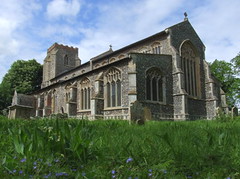
The Suffolk village of Wingfield can trace its origins back to Anglo-Saxon times, but it was the Wingfield family who transformed it into one of the county’s most remarkable medieval settlements.
The family had held the manor from shortly after the Norman Conquest, and their fortunes rose dramatically under Sir John de Wingfield, who died around 1360 after serving as steward to the Black Prince. His descendants went on to build the impressive Wingfield Castle, Wingfield College and the magnificent Church of St Andrew, leaving a legacy that still dominates the village today.
As the family expanded, a junior branch settled at Letheringham. Among its most distinguished members was Sir Humphrey Wingfield (c.1484–1545), the twelfth son of Sir John Wingfield of Letheringham. Trained at Gray’s Inn, Sir Humphrey enjoyed a distinguished legal and political career, serving as Speaker of the House of Commons between 1533 and 1536.
His career also brought him into close contact with Cardinal Thomas Wolsey (1473–1530), Ipswich’s most famous son. The two men were related through Wolsey’s mother, and Sir Humphrey played an active role in establishing Cardinal’s College in Ipswich in 1528. History, however, has a sense of irony. Following Wolsey’s dramatic fall from power in 1530, Sir Humphrey was commissioned by the Crown to investigate the forfeiture of the very college he had helped create.

Today, Wolsey is commemorated in Ipswich by a striking seated statue, erected largely through the efforts of the late historian Dr John Blatchly.

Sir Humphrey built Wingfield House on Tacket Street in Ipswich, one of the grandest Tudor houses in the town. It became famous when his son, Sir Anthony Wingfield, entertained Queen Mary (1516–1558) there. The centrepiece was the magnificent Great Parlour, described by contemporaries as being “fit for a queen” and regarded as one of the finest Tudor interiors in East Anglia.

The story takes an unexpected turn through the pages of our own family records.
When the Trust acquired the St Mary at the Quay Marriage Register (1813–1837), reported in Cobbweb in March 2017, we noted the marriage of Rev. John Edge Daniels (1805–1888) #4328 to Mary Aldrich (1805–1889) #4327 in 1830. Their marriage entry is remarkable, being witnessed by no fewer than sixteen members of the family.
Only later did we discover another fascinating connection. Rev. John Daniels was appointed Perpetual Curate of St Andrew’s Church, Wingfield, linking our family directly with the village’s remarkable history. He later moved to Rushmere St Andrew, near Ipswich, where he spent the final forty-seven years of his life, while also serving as Chaplain to the Suffolk County Prison.
Meanwhile, Wingfield House entered a new chapter. By 1736 it had become the Tankard Inn, was rebuilt in 1802 and suffered a devastating fire in 1843. Following its reconstruction it became known as the Theatre Tavern, and much of the building that survives today dates from that rebuilding.
Yet one priceless feature escaped destruction.
When the Tankard name was restored in 1880, the magnificent Tudor panelling from Sir Humphrey’s Great Parlour was carefully removed and installed at the Cobbold family home at Holywells. There it remained, admired for half a century, until Holywells was sold in 1930.

Fortunately, the story did not end there. The family donated the panelling to Christchurch Mansion, where a special room was created to house it. Visitors can still admire this extraordinary Tudor interior today.
What may once have seemed a selfish decision to remove the panelling from its original setting ultimately ensured its survival. Thanks to that move—from Wingfield House to Holywells, and finally to Christchurch Mansion—a substantial part of Sir Humphrey Wingfield’s magnificent Great Parlour, the room once considered “fit for a queen”, has been preserved for more than 470 years for future generations to enjoy.
Anthony Cobbold


