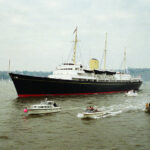
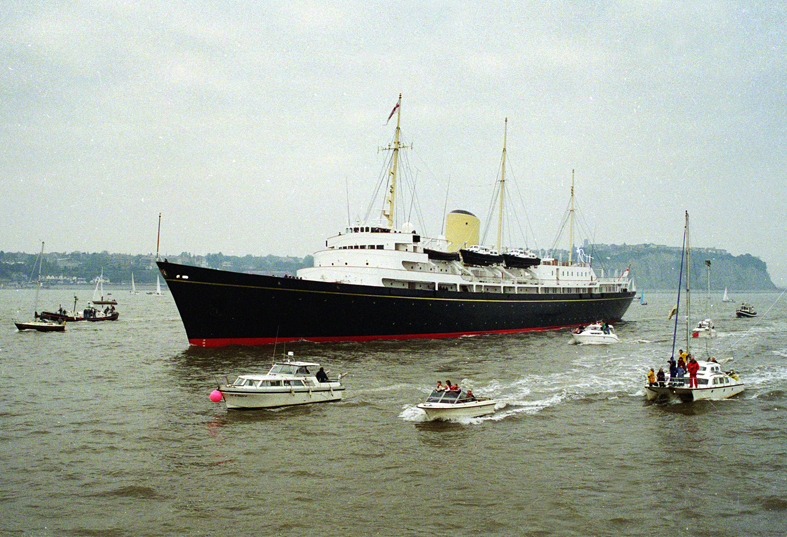
Surprisingly, there have been 82 Royal Yachts since Charles II in 1660. The only other one to be named Britannia was a racing cutter built for the Prince of Wales in 1893.

‘Our’ Britannia was launched by Her Late Majesty Queen Elizabeth II at John Brown’s Clydebank shipyard on 16th April 1953. She was designed to be capable of conversion into a hospital ship in time of war though this function remained unfulfilled.

Traditionally the Royal Yacht was skippered by a Rear-Admiral whose appointment was termed Flag Officer Royal Yachts (FORY) even though there was only the one vessel. In Queen Victoria’s day her royal yacht was at the centre of a Royal Yacht Squadron comprising a number of other vessels one of which was a back-up for hers; hence the job title which has remained unchanged down the years.
The Rear-Admiral commanded the whole squadron and this practice continued into the 1980s as we shall see in part 2. His job has been described as the best job in the entire navy and in recognition of his responsibilities for protecting the sovereign and undertaking many sensitive diplomatic duties he became a member of the Royal Household. The yacht’s crew, all volunteers, were known as ‘Yotties’ and could stay on the yacht for their whole career subject to good behaviour.
From September 1990 to April 1995 FORY was Rear-Admiral Sir Robert Woodard KCVO DL (1939) #860, both of whose sons Rupert (1964) #873 and Jolyon (1969) #875 also served briefly on the yacht. In the course of her life H M Y Britannia travelled more than a million miles.

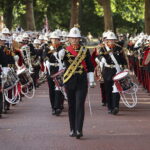
When in an overseas port, awaiting the arrival or following the departure of her Majesty, the Yacht would host widely-envied trade missions. Nobody would decline an invitation to dine on board the British Sovereign’s personal floating palace. A typical evening would comprise a formal reception after which guests would go to the ship’s rail to enjoy lively airs and the beat of the drum provided by the Royal Yacht Band, a detachment of the Royal Marines in ceremonial dress culminating in ‘Land of Hope and Glory’ and, as the sun went down, the emotional ‘Last Post.’

During the performance and unknown to the guests, the reception area was seamlessly transformed for a state banquet by minute-conscious yotties working silently at high speed. In the middle of the magnificent glittering table stood a pair of spectacular gold centre pieces, one of which had been found in an antique shop by a yottie and returned to its rightful place.
Of course the guests were impressed by their personal slice of legendary British Pomp.
Woodard recalls that on one occasion an elated and excited midland industrialist hurried to give him a rapturous bear hug because he had just sold a £1½ million sausage making machine!
That time it was neither sizzle nor sausage.
Anthony Cobbold