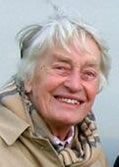
Anne (1924-2012) #74 on the family tree who was born on St. Anne’s Day and baptised by her grandfather, Rev. Robert Russell Cobbold (1853-1925) spent her childhood in Northamptonshire with fond memories of family seaside holidays in Salthouse, Norfolk. She was clearly an impressionable child with a strong sense of justice. Her brother Dick became a Benedictine Mink and Anne’s memoir records her concern for the poor and particularly for the thousands of working men who during the Great Depression marched to London asking for work. She recalls the good woman who resorted to stealing eggs to feed her starving family.
As a 17 year old Anne lied about her age and joined the Women’s Royal Naval Service. Unknown to her family at the time Anne was one of the 9000 women selected for their integrity and intelligence to work at Bletchley Park. As a signatory to the Official Secrets Act she could not, and never did, reveal the crucial part she played whilst there. On the Bletchley Park Roll of Honour she is merely listed as WRNS personnel. In 1944 she was posted to Colombo in Ceylon (as it then was) where she worked in the Royal Navy code breakers and wireless interception centre.
Based at the Far East Combined Bureau which was housed in an Indian boys’ school called Pembroke College she became a Japanese code breaker. Sadly she never received a medal in recognition of her work because her stay in Ceylon fell one month short of the 1 year qualifying period.
After the war Anne went up to Girton College, Cambridge where she met and married Peter Francis and they had 6 children including 2 sets of twins. Anne’s concern for the less fortunate never left her. In addition to her own children she became a foster mother to two young girls and served as surrogate mother to three young nurses from Sri Lanka. Anne recognised the benefits of diversity long before it became fashionable. She was one who helped win the war and went on to win the peace too.