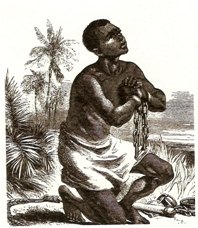
This narrative poem, subtitled An African Story was written by Eliza Knipe (#58 in the tree) in 1787 when she was 23 years old and 4 years before she became John Cobbold’s second wife. Her young idealistic mind revolted fiercely against slavery.
Atomboka is described as ‘the peerless Chief, high towering in his might’ and Omaza as ‘The dark-brown beauty often praised in song, herself well skilled to throw the certain lance.’ They fight a fierce battle in defence of their freedom to the cry ‘Lift high the axe’ but they are defeated. The poem finishes:
A pond’rous chain they twin’d, and on a car
Of woven canes, beset with thorns,
In pomp barbaric, dragg’d them o’er the plain.
They heav’d no sigh; with patient scorn they brav’d
Insult and pain: the instruments of death
Pleas’d their glad fight; and on the tort’ring fire
They smil’d serene, and hail’d its rising blaze.
From a tall rock, a warrior-youth descry’d
A gallant ship that, bounding o’er the waves,
Spread her white wings, and hasted to the shore.
He gave the well-known sign. – On ev’ry side
Calm silence spread; exulting clamour ceas’d;
Av’rice prevailed: down to the sandy beach
They led their patient captives: soon the ship
Arriv’d, and paid their price. – Two changing moons,
Oe’r the wide earth, had spread their silver light,
E’er, from surrounding hills, the wretched train
To slav’ry doom’d were brought. – In silent woe
Full many an hour proud Atomboka spent;
While sad Omaza, with heart-rending groans,
Indulg’d the keener transports of despair.
The vessel spread her sails. – The distant shore
Now lessen’d on the view. – Still ev’ning rob’d
The skies in sober grey; and the red light
Of parting day scarce ting’d the western verge
Of the slow rolling ocean. High in east,
The orb of night with paler radiance shone
And silver’d o’er the waves. – From the close hold
Sad Atomboka and Omaza stole:
The massy chain with steady care they bore,
That not a clanking link, with tell-tale noise,
Betray’d their flight. – Silent and unobserv’d
They pass’d the sleepy watch, and to the side
Of the tall vessel sped; there, stooping, view’d
The passing waves with many a sorr’wing look:
Then low, in fearful whispers, thus explain’d
The mournful thoughts that rose in either breast.
Atomboka
See, my Omaza, how the waters glide,
In sportive mock’ry by: they do not know
The harshness of captivity: No pow’r
Can fix a chain on them, or make them leave
Their native bed: but we are doom’d to roam
Far from all social joys: perhaps, beneath
Inclement skies, to toil at the harsh will
Of a capricious master, or endure
The painful scourge, inflicted by a wretch
Whose soul enjoys a fellow-creature’s pangs.
Omaza
O never will we yield to such a fate;
No rather, from some high and craggy rock,
We’ll dash ourselves, and, in the barren vale,
Feed the fell tigers and devouring birds.
Atomboka
Thy fancy raves; where shall the craggy rock
Be found, when, chain’d to some strong stake, we feel
The lash of pow’r? methinks the gentle waves
Invite us to repose, and, murm’ring soft,
Say, ‘Rest, O mortals, from the toils of life!’
Omaza
‘Tis greatly thought! Borne on the rolling main,
We soon shall reach that blissful island where
Our fathers’ spirits rest, and with them raise
The song of triumph. – Our insulting foes
Shall lose their promis’d vengeance.—
Atomboka
Hark! I hear a ghost’s shrill voice! It chides our dull delay,
And waits to guide us to the happy shore.
Sudden they plung’d, clasp’d in a fond embrace,
And, o’er their heads, the closing waters roll’d.