
We are interested in Benjamin William Page (1765-1845) #15136 for more than one reason.

Apart from his intense naval career his nephew Rev Luke Flood Page (1805-1863) #113 married Susannah Elizabeth Cobbold (1803-1869) #112, granddaughter of Rev Thomas Cobbold (1742-1831) #51 who should have taken on the brewery but chose the Church instead. Their son, Lt. Spencer Cobbold Page (1833-1857) #3319 who died accidentally in Belize is the subject of another poignant story to be recorded later.
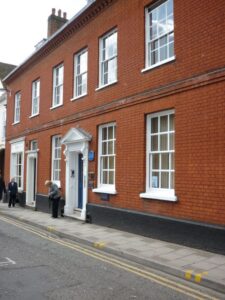
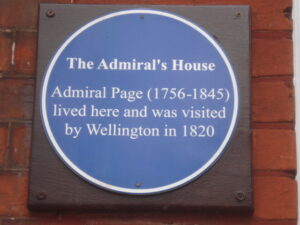
Page lived and died in retirement at 13 Tower Street, Ipswich, now occupied by the Ipswich Institute, a near neighbour of the Cobbolds at number 19, where he was visited by the Duke of Wellington just 5 years after his victory at Waterloo. The Trust published Letters from Waterloo in July 2016.
For an account of his naval life, we can do no better than to quote his entry in the Dictionary of National Biography:
PAGE, BENJAMIN WILLIAM (1765–1845), admiral, born at Ipswich on 7 Feb. 1765, entered the navy in November 1778, under the patronage of Sir Edward Hughes with whom he went out to the East Indies in the Superb, and in her was present in the first four actions with Suffren. In December 1782 he was appointed acting lieutenant of the Exeter, and in her took part in the fifth action, on 20 June 1783. In August he was moved into the Worcester; in the following February to the Lizard sloop; and in September to the Eurydice frigate, in which he returned to England in July 1785. His commission as lieutenant was then confirmed, dating from 20 Nov. 1784. From 1786 to 1790 he was on the Jamaica station in the Astræa frigate, commanded by Captain Peter Rainier, whom he followed to the Monarch in the Channel for a few months during the Spanish armament. In December 1790 he was appointed to the Minerva, in which he went out to the East Indies; in August he was transferred to the Crown, and in her returned to England in July 1792. In January 1793 he was appointed to the Suffolk, again with Rainier, and in the spring of 1794 went out in her to the East Indies. In September Rainier promoted him to command the Hobart sloop, a promotion afterwards confirmed, but only to date from 12 April 1796.

In consequence of Page’s long acquaintance with eastern seas, he was ordered, in January 1796, to pilot the squadron through the intricate passages leading to the Moluccas, which were taken possession of without resistance, and proved a very rich prize, each of the captains present receiving, it was said, 15,000l. Unfortunately for Page, some important despatches were found on board a Dutch brig which was taken on the way, and the Hobart was sent with them to Calcutta. Page was thus absent when Amboyna was captured, and did not share in the prize money (James, Nav. Hist. i. 415). In December 1796 he convoyed the China trade from Penang to Bombay with a care and success for which he was specially thanked by the government, and by the merchants presented with five hundred guineas. In February 1797 he was appointed acting captain of the Orpheus frigate, but a few months later he received his post rank from the admiralty, dated 22 Dec. 1796, and was ordered to return to England. In January 1800 he was appointed to the Inflexible, which, without her lower-deck guns, was employed during the next two years on transport service in the Mediterranean. She was paid off in March 1802, and in November Page commissioned the Caroline frigate, in which in the following summer he went to the East Indies, where he captured several of the enemy’s privateers, and especially two in the Bay of Bengal, for which service the merchants of Bombay and of Madras severally voted him a present of five hundred guineas. In February 1805 he was transferred to the Trident, as flag-captain to Vice-admiral Rainier, with whom he returned to England in October. In 1809–10 Page commanded the sea-fencibles of the Harwich district, and from 1812 to 1815 the Puissant guardship at Spithead. He had no further service afloat, but became, in course of seniority, rear-admiral on 12 Aug. 1819, vice-admiral 22 July 1830, admiral 23 Aug. 1841. During his retirement he resided principally at Ipswich, and there he died on 3 Oct. 1845. He had married Elizabeth, only child of John Herbert of Totness in Devonshire; she died without issue in 1834.

Anthony Cobbold


