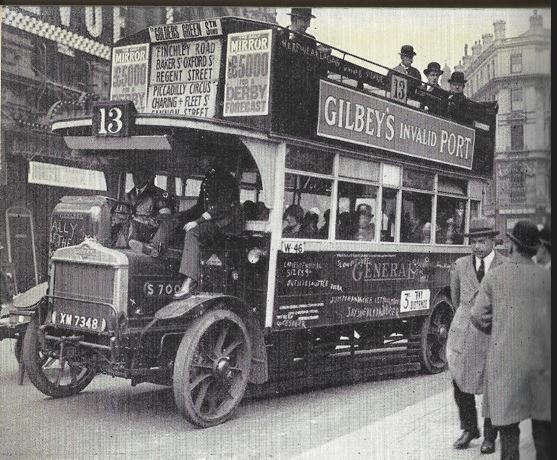
With widespread strikes complicating life today it may be a good moment to record a little tale about the General Strike nearly 100 years ago.
With warning of strike action, the Government of the day made a series of plans to cover various industries. For instance, volunteers drove London buses but with a police escort.
At several London power stations naval ratings, many of them stokers, were ready to move in as trade unionists moved out. They provided only a skeleton staff, supplemented in most cases by technicians who did not come out. A Cambridge undergraduate was taken to Islington Power Station, with several companions, in a police convoy. He wrote to his mother and father:
“We arrived safely at the power station, where the gates opened and closed behind us like a prison. In all there were about 50 of us up there, 20 volunteers, 20 of the permanent staff and 10 or 12 seamen who helped with the stoking.”
This boy worked on the main steam turbine for a day or two, reading gauges and meters, and then shifted to the coaling gang:
“This new game was the goods as far as work was concerned, and although very dirty was very enjoyable. We had to climb into the grate of one of the boilers, and remove soot from the side and from the masses of water tubes which formed the ‘roof’. It was just like going up a chimney which hasn’t been swept for years. However, it was an experience, and had to be done, and we all did it in good spirits, laughing about the ‘soot pudding’ with which it filled our mouths.
That undergraduate was my father (Rowland Hope Cobbold 1905-1986 #407).
Looking through some of his papers I found his 10-page letter to his mum and dad but surprisingly I also found a letter, dated 1956, from Julian Symons thanking my father for responding to his letter in The Times. He explained that descriptive letters of the kind my father had sent were just the sort of thing he was hoping to obtain for the book he was writing.
I was easily able to buy a copy of Julian Symons book The General Strike 1957 and in which I found the piece quoted above. I don’t think my father ever knew of his moment in print.
Anthony Cobbold