A Recent purchase
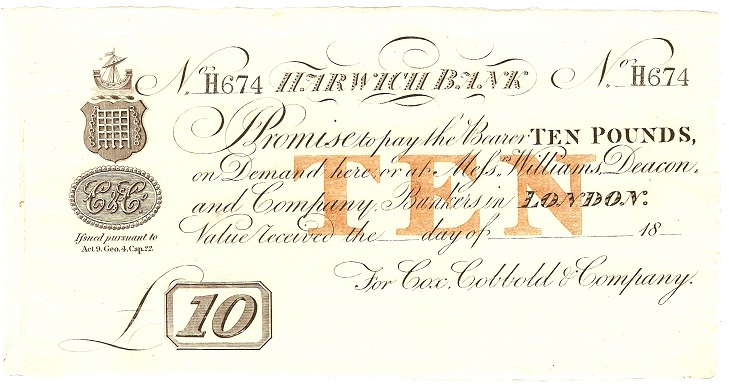
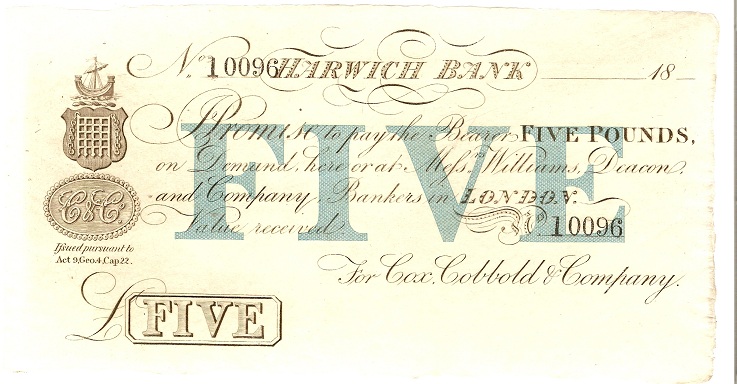
The Cox family had been bankers in Harwich, Essex since the 1770s when John Cobbold (1774-1860) (#77 in tree), already a successful brewer, entered a partnership with Anthony Cox in 1839 to form the Harwich Bank by Cox, Cobbold & Company which traded until 1893. The Harwich Bank issued only £10 and £5 notes, of which The Cobbold Family History Trust (CFHT) has acquired un-issued examples of both probably printed between 1846 and 1887.
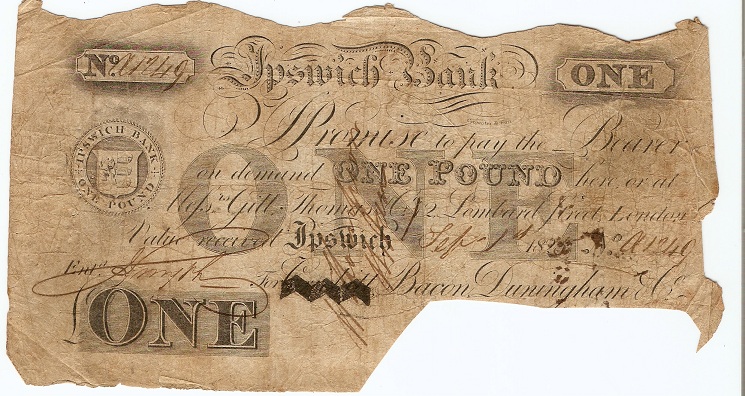
In Ipswich, Suffolk the Crickitt, Truelove, Kerridge, Duningham and Bacon families had also been bankers under a number of names since the 1780s in common with many other wealthy families who owned the 300 or so country or ‘provincial’ banks. The banker’s aim was to confine his notes to the immediate locality, where they would be recognised and trusted, and hopefully remain in circulation for a long time. Once outside the vicinity, the notes would gravitate to his London agent for redemption. The CFHT also has a £1 note issued by Crickitt, Bacon, Duningham & Co just prior to the 1825 bank crisis, which was wrongly described by the vendor as being Cobbold, Bacon, Rodwell, Dunningham & Co.
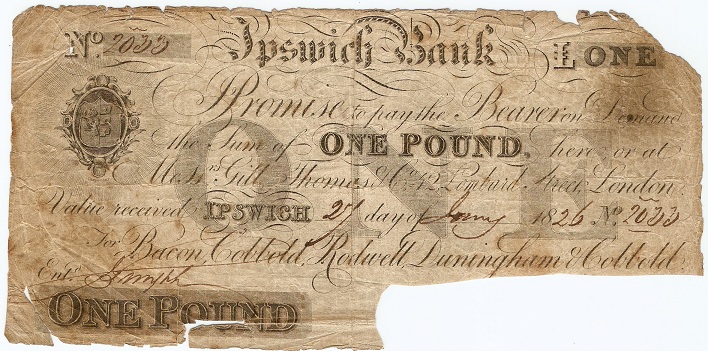
The crisis saw the collapse of many private banks. A major factor was the over-issuing of notes such that they could not be honoured if a number came in for payment together. The collapse of one or two banks caused a run on the others and general panic set in. The Ipswich Bank would have failed but for the injection of new capital by William Rodwell, John Cobbold (1774-1860) and his son, John Chevallier Cobbold (1797-1882) (#114) who formed Bacon, Cobbold, Rodwell, Duningham and Cobbold in 1826, the CFHT having an example of their £1 note No. 2033 issued 27th January 1826.
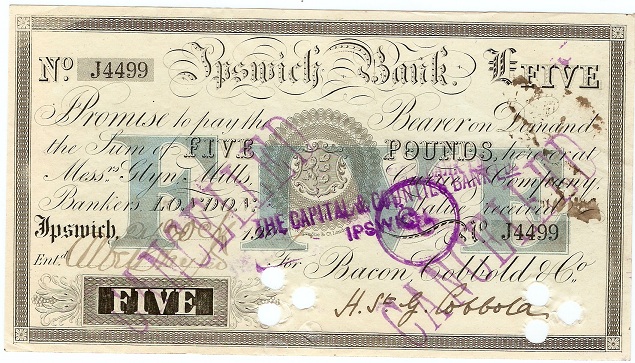
It seems that Duningham withdrew in the 1840s and Rodwell in the 1870s but the bank was joined by Douglas Tollemache (also a Suffolk brewer) for a few years in 1885. Cox Cobbold & Co from Harwich merged with the Ipswich Bank in 1893 and the new business, Bacon Cobbold and Co soldiered on until 1904 when it was taken over by Capital and Counties which was itself subsequently absorbed into Lloyds. The last banknote in the CFHT purchase is a £5 note, No. J4499 issued 24th October 1904 by Bacon Cobbold and Co signed by H. St. G. Cobbold (1871-1944) (#323) which is stamped to show that it was redeemed and subsequently cancelled by Capital & Counties Bank in Ipswich.
Herbert St George Cobbold seems to have been the last man standing in Cobbold banking terms. His father, Ernest St George (1840-1895) (#199) had run the Woodbridge Branch of Bacon Cobbold and his uncle, Felix Thornley (1841-1909) (#201) had returned from his preferred academic life in Cambridge expressly to help out. Herbert had been educated at Haileybury, was a director of a number of companies, married his first cousin, Evelyn Anna Cobbold (1873-1959) (#322) and purchased the Rookery Estate at Sproughton with some 48 acres. After the take-over he became the local director and his cousin, Herbert Jervis-White-Jervis (1858-1934) (#1424) who had been working with him, joined the London Board of Capital and Counties.