Fadge was a wartime dish which sustained hundreds during severe rationing. The recipe says quite simply:
Mix Self Raising flour into cold mashed potato, shape into a round and cut diagonally into 6 pieces. Cook in a frying pan in lard.
I recollect that it turned out a bit like today’s Hash Browns but it filled little stomachs two or three times a week, as a main course, not a side.
This is one of hundreds of wartime economy recipes inherited by the Trust amongst an extraordinary collection assembled by Mary Selby Parkin (1908-2000) #408.

The basis of her collection is a carefully hand-written notebook of her attendance at a Housewifery Course at Hill Brow in October 1924.
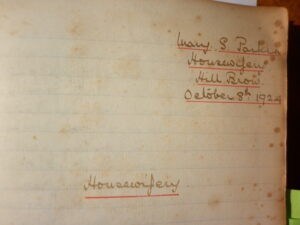
Amongst instructions on washing up we learn that all scraps should be burned; that the handles of knives must never go in the water; that tea pots when put away should have their lids tipped up and that copper saucepans should be cleaned with soap and sand and polished with whitening.
Bedroom care includes instructions to empty the chamber pot; turn the mattress and fold the nightgown and put it in its case. Lavatories, if neglected, should be emptied using a gally pot, dosed with spirits of salt (Hydrochloric Acid), scoured with a flannel on the end of a stick, and then flushed repeatedly.
The backs of Ivory hair brushes should be cleaned with lemon juice to prevent them going yellow but the backs of Tortoise-shell hair brushes should be cleaned with jewellers’ rouge and a little salad oil.
Some space is given to improved designs of open fireplaces but even more is consumed by the new methods of heating and lighting, gas and electricity. The latter is favoured for domestic use although it is more expensive. Supply controlled by switches which can be turned on and off as required. Detailed instructions are given on the use and maintenance of oil lamps.
Comprehensive advice on drainage is included and dustbins should be made of galvanized iron, round with handles, lidded and emptied once a week. The cleaning product GOSPO was popular at that time; remembered by older users for its strong cleaning power in laundry and household applications.
Tucked into the note book are some hundreds of recipes mostly dating from the 1950s when rationing was still in place. It would be a veritable feast for a cookery writer interested in that period. A message from Canada told us how to reconstitute dried eggs and how to use them, and Carnation Milk (remember it?) reminded us of the delights of Gooseberry Fool.
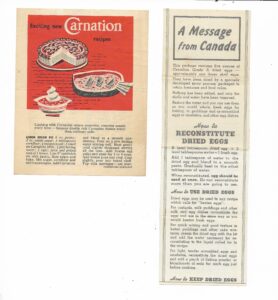
Those relating to war time restrictions include Mock Sausages, home made Tomato Ketchup and Salad Cream, Canadian War Cake, Mock Cream, a 10-minute Paté, and a Cake that needs no Cooking.
Less restricted offerings include Nutty Flips, Bourbon Biscuits, Valentines, Brandy Snaps, Fumets, Mint Jelly, Kedgeree, Coffee Kisses and Mrs. Goronwy’s Marmalade Tart. For the more sophisticated there is Scampie en Papillotte Aldous (Prawns in a Paper Bag).
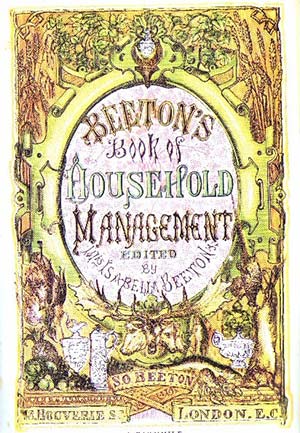
Included in the collection is an oft-consulted but now disbound first edition of Mrs Beeton’s Cookery Book published by Ward Lock & Co Limited in 1901 at one shilling. This was a scaled-down version of the renowned Mrs Beeton’s Household Management published in 1861 (it sold 60 thousand in its first year and 2 million in the second).
Isabella Beeton was the Mary Berry of her day.
Her preface to the first edition says that the book is “To help both mistress and servant to a knowledge of some of their duties, and to assist them in the important task of dressing and serving daily food.”
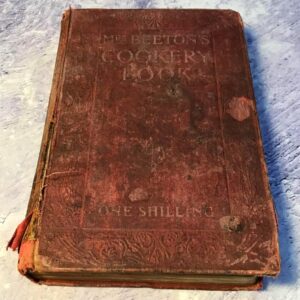
In doing so it gives us an encyclopedic peep behind the scenes of well-to-do households at the beginning of the 20th century. Fascinating!
Anthony Cobbold