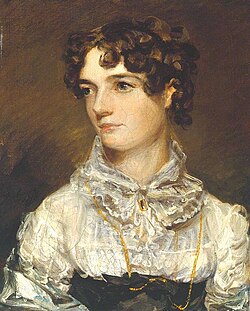
Nothing is more important at present to the people of Ipswich than Constable 250. Nobody is more important to Constable 250 than Emma Roodhouse, Art Collections and Learning Curator at Colchester & Ipswich Museums Service, (why do we tolerate such long-winded titles? – She is the Curator, full stop.) now elevated by her recent secondment at the Tate in London, to international standing.
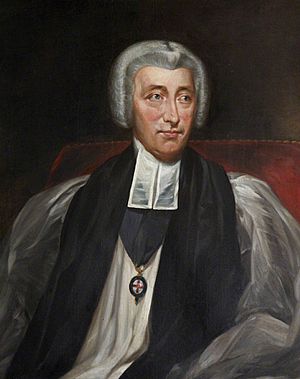
Imagine my surprise when I discovered that members of our extended family were amongst Constable’s greatest supporters. No, I am not talking about Elizabeth Cobbold, Georgian polymath, although she entertained Constable and other artists at the Cliff and encouraged him to sketch her step daughters, but I am talking about Bishop Dr. John Fisher (1748-1825) #15411.
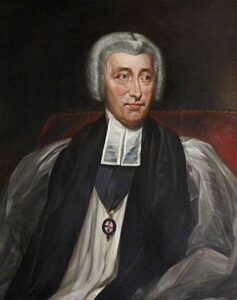
My grandmother’s sister, Mabel Parkes (1864-1890) #914, married into the Levett-Scrivener family at Sibton Abbey, Suffolk and it was Levett-Scrivener money which had propelled John Fisher’s preferment. This John Fisher was a Fellow of St. John’s College, Cambridge, and tutor to the 13-year-old son of George III.
Gaining the king’s confidence, John Fisher became Royal Chaplain and Treasurer to the Dean and Chapter of St. George’s Chapel, Windsor. Little surprise that he soon became known as the ‘King’s Fisher.’
Dorothea, his heiress wife (1762-1831) #15410 is said to have ‘adored him’ and ‘brought him a large fortune.’ In 1802 he was appointed Bishop of Exeter and only five years later he was translated to Salisbury and became Chancellor of the Order of the Garter, with a grace and favour dwelling in Windsor.
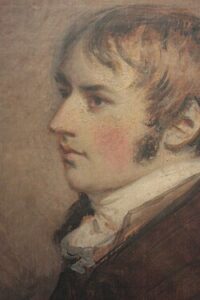
As well as knowing his way around the Church hierarchy, John Fisher was a talented sketcher and when he and Constable met, this shared ability brought them together. Fisher was appointed Chaplain to the Royal Academy. Aged just 33, Constable was home in East Bergholt where he became re-acquainted with Maria Bicknell the granddaughter of the rector. They fell in love but were too poor to marry.
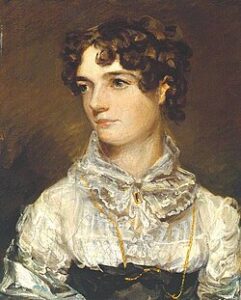
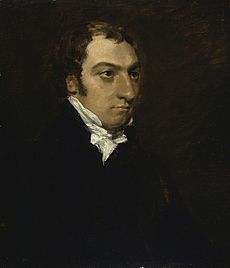
In the autumn of 1811 Constable spent three weeks in Salisbury as the guest of John and Dorothea Fisher. There he met Fisher’s brother Rev. Dr. Philip Fisher (1750-1842) #15414 who was Master of Charterhouse School in London, but more importantly the Master’s son, Archdeacon John Fisher (1788-1832) #15416 who was to become Constable’s closest friend and confidant. After some years of painful waiting Constable’s small inheritance from his father’s death was sufficient for him to be married in 1816 to his ever-patient Maria by the Bishop’s nephew at St. Martin-in-the-Fields, London.
Their courtship had not been easy. Although Maria loved John dearly, her family boasted three generations of lawyers and felt themselves superior to the Constable corn and coal merchants. Maria, though she always respected John’s talent, was well able to defend her own corner.
After the wedding John and Maria visited the bishop and his wife in Salisbury and then went on to stay for six weeks with young John Fisher and his wife Mary at Osmington in Dorset. It was said by James Hamilton that “John Fisher the younger made Constable laugh and took him out of himself. Friendship with the amusing nephew of the Bishop of Salisbury was new, vital, and sophisticated and at an appropriate social level. John Fisher became the friend who offered more than Constable could ever expect, with opportunity and access discreetly in the background.”
Between 1817 and 1828 Maria bore seven children. The last, Lionel, born early in January, seemed to have sapped Maria’s strength, for she never really recovered. John knew she was ill but her doctors concealed the truth and despite his optimism the cherished mother of his children died in his arms at only forty-one. He mourned her for the rest of his life.
The bishop had died in 1825 and by 1831 John was starting to feel the effects of rheumatism and the following year he suffered the loss of his most trustworthy friend and confidant, the Archdeacon, who, despite being rushed to Boulogne for better air, died of cholera. The younger Fisher had been a major influence in John Constable’s life, buying both The White Horse (1819) and Stratford Mill (1820), both ‘six-footers’ which had established an increasing confidence in his work and growing recognition.
His loss came as a profound shock and Constable mourned him deeply. ‘I cannot say but this very sudden and awful event has strongly affected me’ he wrote to C. R. Leslie. ‘The closest intimacy had subsisted for many years between us – we loved each other and confided in each other entirely – and this makes a sad gap in my life and worldly prospects.’
Despite exhaustive searches we have been unable to establish any familial link between these Fishers and Geoffrey Francis Fisher (1887-1972) #12989, who was the 99th Archbishop of Canterbury from 1945 to 1961.
Anthony Cobbold