‘The 5th Earl of Cranbrook who has died aged 93 made his name as a professional field naturalist and a leading authority on the ornithology and mammalogy of south-east Asia – as well a pioneering zoo-archaeologist.’
Daily Telegraph 7th September 2026

The Earldom was created in 1892 for his great grandfather, Gathorne-Hardy, a Conservative politician who held Cabinet office in every Conservative government between 1858 and 1892.
The Earl lived at Glemham House, Great Glemham, so was a neighbour of, and friendly with the Cobbolds at Glemham Hall. Indeed, he and Lady Cranbrook visited the Trust’s exhibition in the dining room there, devoted to the works of Elizabeth Cobbold (1765-1824) #58 and her son, Richard in 2008. The Earl had a fine collection of books by Suffolk writers, which included works by both.
Whilst exploring the Niah cave complex in Sarawak, where there was evidence of human habitation 40,000 years ago, he became intrigued by the life cycle of the edible-nest swiftlet (Aerodramus fuciphagus), a tiny bird which builds nests out of saliva; nests which command high prices for traditional bird’s nest soup. He established that they enlarge their salivary glands specifically for the breeding season, which prompted the implementation of seasonal harvesting bans.
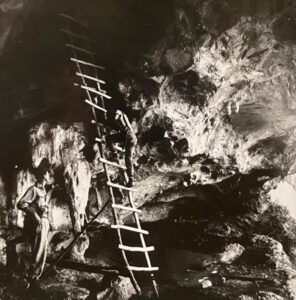
His book, Swiftlets of Borneo with Lim Chan Koon (2002), reveals that, like bats, the birds navigate in pitch darkness by echolocation, using rapid clicking sounds as a biological sonar system.

From 1970 he made regular return visits to south-east Asia, leading field expeditions and helping to develop conservation plans for national parks and other protected areas. In addition to his vigorous activities overseas he was chairman of English Heritage.
After Eton, National Service in the Royal Artillery and studying at Corpus Christi College, Cambridge where he obtained his doctorate in natural and moral sciences, he headed off to teach zoology at the University of Malaya in Kuala Lumpur. Whilst there, he obtained Nuffield Foundation funding for the Ulu Gombak Field Centre, which remains active to this day.
Back home, in Parliament his maiden speech was (of course) on conservation and he established himself as an authority on environmental matters and he served three terms as chairman of the European Communities environment sub-committee before losing his seat in 1999 to the Blair government’s reforms. If ever there was an example of regrettable lost experience, this is it.
Nevertheless, his knowledge was welcomed by English Nature and he served as chairman of the Institute for European Environmental Policy from 1990 to 2006. In 1991-2 he was joint leader of a rainforest project in Brunei, which led to the establishment of the Kuala Belalong Field Centre and Brunei’s first national park.
He wrote or contributed to more than a dozen books and, closer to home, he served as president of the Suffolk Wildlife Trust and of the Sutton Hoo Society. He was a district councillor and clerk for his local parish council for 15 years.
Amongst many honours he was a Deputy Lieutenant of Suffolk and the holder of Royal Geographical Society’s Founders Gold Medal. In 2014 he received the World Wildlife Fund Duke of Edinburgh Conservation Award.

As one commentator put it “The Earl of Cranbrook never fussed about his status, was ever enthusiastic, ever energetic, always patient and curious – he lived many lives and lived them well – his legacy will surely endure.”
Anthony Cobbold