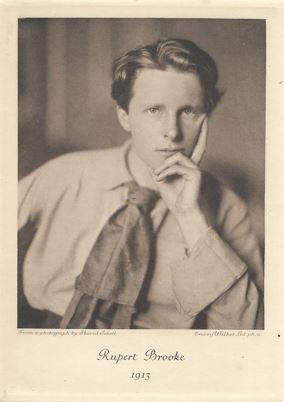
Though not on the Cobbold family tree, Rupert Chawner Brooke (3 Aug 1887- 23 Apr 1915), a poet, is of compelling interest as a colourful example of a middle-class English life at the time of World War I. The Cobbold family has enjoyed a tangential relationship with him since his all-too-short but well-lived life ended in Greek waters. Educated at Rugby (known for discipline) and King’s College, Cambridge (known for scholarship) he volunteered as soon as war broke out and was on his way to the front when a mosquito bite turned sceptic and he died of sepsis on a hospital ship. His most famous legacy is The Soldier written in 1914 and first published in 1915.
The Soldier
If I should die, think only this of me:
That there’s some corner of a foreign field
That is for ever England. There shall be
In that rich earth a richer dust concealed;
A dust whom England bore, shaped, made aware,
Gave once, her flowers to love, her ways to roam,
A body of England’s, breathing English air,
Washed by the rivers, blest by suns of home.
And think, this heart, all evil shed away,
A pulse in the eternal mind, no less
Gives somewhere back the thoughts by England given;
Her sights and sounds; dreams happy as her day;
And laughter, learnt of friends; and gentleness,
In hearts at peace, under an English heaven.
‘In this rich earth a richer dust concealed that is for ever England’ is the inscription on Maj. Robert Nevill Cobbold’s headstone at Monte Cassino. #470. He died for his country shortly before D-Day 1944.
On volunteering Rupert Brooke joined the Hood Battalion of the Royal Naval Division. This unit was like no other in the British Army in that it was manned by members of the Royal Navy Volunteer Reserve who were in effect soldiers, but bound by the rules and practices of the Royal Navy. This unique body was set up by Winston Churchill #14956 when he was First Lord of the Admiralty and was dubbed ‘Winston’s Little Army’ by then Prime Minister Asquith. Possibly because of its unusual constitution it attracted a number of high calibre officers, amongst them Oc Asquith (the Prime Minister’s son), Patrick Shaw-Stewart and Bernard Freyberg #3173. These three were in the sombre funeral party which buried Brooke on the little Greek island of Skyros. They hastily erected a cross at the head of his grave, a smaller one at the foot being given spontaneously by members of his platoon.
The Hood Battalion was on its way to the Dardanelles when Brooke was taken ill. The unit went on to engage in some of the fiercest fighting of the war at Gallipoli and on the Western Front at Ancre, Gavrelle and Passchendaele. Freyberg was awarded the Victoria Cross towards the final stages of the battle of the Somme.
As John Simpson said when his 25-year-old translator was killed by friendly fire in Iraq:
“The one duty I can perform is not to forget”
Anthony Cobbold