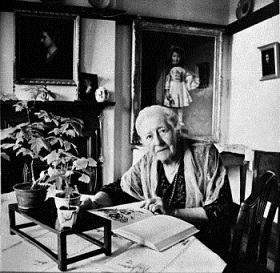
This is a little account of two high-achieving people who, although married, seem at first sight an unlikely combination. Both were thrusting determined people but both had a softer underside.
Barnett was Brigadier-General Barnett Dyer Lempriere Gray Anley CMG DSO, General Officer Commanding 183rd Infantry Brigade on the Western Front in WWI and Gwendolyn was a gardener, but by all accounts a gardener of extraordinarily diverse talents. Her no-nonsense attitude was evident when, on arrival at their house, St George’s in Woking, the greeting on the front gate told you ‘Considerate people will shut this gate; others are requested to do so.’ Assuming you were invited in doors there was not much encouragement to be had from the sign over the fireplace in the study which instructed ‘If you have nothing to do, please don’t do it here.’ Despite this gruff exterior guests were always most welcome and received nearly as much tender loving care as her plants. Alpines were one of her interests and her book ‘Alpine House Culture for Amateurs’ published in 1938 was the standard work on the topic for many years. She is said to have amassed a collection of some 40 varieties of Snowdrop but probably her most enduring passion was Bearded Irises, including her own ‘Iris Gwendolyn Anley’ which led to the publication of ‘Irises, Their Cultivation and Selection’ in 1946.
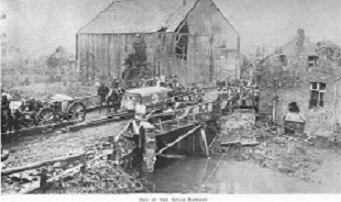
The Brigadier-General (born in 1873) was the son of an army officer; joined the Essex Regiment and found himself Adjutant of the 6th Battalion Mounted Infantry in the Boer War where he won a DSO and was twice mentioned in despatches. After Staff College he was transferred to the Manchester Regiment and commanded the 1st Battalion for 3 months in 1915 before being wounded. January 1916 saw him back on the Somme as Chief of Staff, 41st Division for a while; this being followed by a spell at HQ Home Forces before taking command of 183rd Brigade which he led in the crossing of the Selle and at Valenciennes. He remained in the army after the war having a number of home commands ahead of his retirement in 1928, whereupon he joined Gwendolyn in the garden, his speciality being hardy border Carnations.
Our diverse couple suffered the worst tragedy imaginable when they lost their only child, Patricia just a few days before her 15th birthday but perhaps in a mysterious way it brought them closer together. It seems that in retirement he had some diplomatic responsibilities which took him and his wife to Japan around 1935. We know nothing of his duties but the visit allowed Gwendolyn to further her study of the art of Bonsai. Whilst there she almost certainly met up with Count and Countess Matsudaira who were the best known growers and collectors of Bonsai at that time and she is known to have been most impressed by their minutely attentive and enthusiastic care. Some time after her return she wrote one chapter ‘Bonsai: An Introduction to the Japanese Art of Dwarfing’ for a book entitled ‘Miniature Gardens’ which is amongst the earliest English Language articles on the topic.
The story is nicely rounded off by the news that in 1995 a pair of Bonsai donated to Kew and now part of their fine display had originated in Gwendolyn’s collection having been given to Kew by her great niece who also provided sufficient history to establish that they are possibly the earliest Bonsai to be imported into Britain that still survive in their original pots.
Note: Barnett and Gwendolyn are # 2966/7 in the family tree.
© 2012 The Cobbold Family History Trust