Margaret Catchpole born, 14th March 1762, died 13th May 1819, does not appear on The Cobbold Family History Trust family tree although many of the characters in her drama do.
The story of Margaret’s life would have passed relatively unnoticed had it not been for Richard Cobbold’s historical novel published some 45 years after the events it described.
The History of Margaret Catchpole: a Suffolk Girl (1845)
It is because of Richard Cobbold’s intervention that The Cobbold Family History Trust has become the generally accepted authority on the subject. This is no light responsibility.

As a writer the Reverend Richard (1797-1877) #106 used his freedom to bend the reality to suit his moral purpose despite his opening sentence which claimed “The heroine of this romantic but perfectly true narrative was born in the year 1773.”
Many of the good folk of Suffolk who remembered the oft-reported events, objected to Richard’s version, and there grew up something akin to a sub-culture of dispute. The variations became the story and a plethora of differences were available for belief.
Stories of varying degrees of inaccuracy exist in people’s minds to this day; and not only in Suffolk. As Margaret was transported to Australia where She has pioneer status the Australian Dictionary of Biography carries an excellent account drawn from seven bibliographical records and no less than sixty-two other resources.
Australian Dictionary of Biography
Margaret Catchpole (1762-1819), convict and pioneer, was born on 14 March 1762, reputedly at Nacton, Suffolk, England, the natural daughter of Elizabeth Catchpole and a farm labourer, although the baptism of a Margaret Catchpole on the same day is recorded in the register of Hoo, near Framlingham, some fifteen miles (24 km) from Nacton. Her early life was spent on the farms where her father worked and she became a skilled horsewoman. She had little formal education, working as a servant for various families until she was employed as under-nurse and under-cook by Mrs John Cobbold, wife of an Ipswich brewer. Here she was more a member of the family than a servant, and was three times responsible for saving the lives of the children in her care; here too she learnt to read and write.
She left the Cobbolds in mid-1795 and, after being seriously ill for months and unemployed, on the night of 23 May 1797 stole John Cobbold’s coach gelding, and rode it seventy miles (113 km) to London in ten hours. She was caught and sentenced to death at Suffolk Summer Assizes. The sentence was commuted to transportation for seven years, but on 25 March 1800 Margaret escaped from Ipswich Gaol using a clothesline to scale the 22-foot (6.7 m) wall. Again, her sentence was death, commuted this time to transportation for life. The simple weft of these facts is criss-crossed by the warp, fiction or otherwise, of her single-minded devotion to William Laud, sailor turned smuggler: she left the Cobbolds because of their disapproval of him, she stole the horse to help him in London, then escaped from gaol to meet and marry him, but Laud was shot dead on a Suffolk beach when Margaret was recaptured.
She was transported in the Nile which reached Sydney on 14 December 1801. For some eighteen months she worked as cook for the commissary, John Palmer, and wrote to her uncle, ‘i am well Beloved By all that know me and that is a Comfort for i all wais Goo into Better Compeney then my self that is a monkest free peopell whear thay mak as much of me as if i was a Laday—Becaus i am the Commiseres Cook’. To this letter is a postscript: ‘i hav at this time a man that keep me Compeney and would marrey me if Lik But i am not for marring he is a gardner he Com out as a Botnes and to Be a Lowed one hundred pound par year’. Many have without question taken this to refer to George Caley who, although he was receiving only £40 a year, could not in any sense be called a gardener. A far more likely candidate is James Gordon, sent out as a botanist by J. A. Woodford of the War Office.
Margaret worked for various well-known families, the Faithfuls, Rouses, Dights, Woods and Skinners. The Rouses respected her ‘as one of ther owen family’, and left her to act alone as overseer on their property at Richmond. She was proud of leading a decent and industrious life, and in her last letter to the Cobbolds on 1 September 1811, wrote ‘i am Liven all a Loon as Befor in a very onest way of Life hear is not one woman in the Coloney Liv like myself’. This theme runs through all her letters together with her longing to be pardoned and return to her ‘owen nativ Land’. She was pardoned on 31 January 1814 but did not return to England, spending the rest of her life keeping a small store at Richmond, acting as midwife and nurse, and always helping others. Her last service was nursing until his death a shepherd, ill with influenza on the Pitts’ property near Richmond; from him she caught the infection and died on 13 May 1819.
Margaret Catchpole’s letters reveal her as a warm, loving, intelligent woman of great integrity. She was one of the few true convict chroniclers with an excellent memory and a gift for recording events. Her letters of 8 October 1806 and 8 October 1809 are the only known eyewitness accounts of the Hawkesbury River floods of those years; she described graphically the countryside, the Aboriginals, and the wildlife; she wrote of the first convict coalminers at Coal River (Newcastle) and of the savagery and immorality of the inhabitants of the colony, and by her writings added richly to Australia’s early history. Richard Cobbold, the son of her former employers, in The History of Margaret Catchpole, 1-3 (London, 1845) provided the source of many plays, books and articles. He distorted the facts brilliantly, rewriting and, in some cases, originating in genteel and proper English Margaret’s letters from Australia to his mother. He chose to attribute Mary Reibey’s successful married life to Margaret, who did not marry, and to this day the lives of the two women are still confused.
The discrepancy over her place of birth may have arisen because Margaret was illegitimate and financial responsibility for base born children in those days lay with the parish of birth so it was not unusual for single mothers to hop into a neighbouring parish just before the event.
Will Laud was a creation of Richard Cobbold’s mind, presumably to give his story some ‘love interest’ and to provide a reason for the theft of the horse. In his absence her reason for stealing the horse remains our biggest unsolved question to this day.
Ten letters home from the colony of New South Wales have survived and these were donated to the Mitchell Library, the State Library of New South Wales, by Augustus Hills Cobbold (1854-1931) #281 in 1922.
The question as to who was the botanist who offered to marry Margaret is a good example of current confusion. The Australian Dictionary of Biography favours James Gordon but he is shown by Wikipedia to have died in 1780. The alternative, George Caley, who is thought to have been active in Australia most of his life, did not die until 1829 and is said to have had a society named after him in St. Ives, New South Wales.
Mrs John Cobbold (1765-1824) #58 who employed Margaret and to whom most of her letters from Australia were addressed, sent Margaret a package of ‘useful items’ (mostly haberdashery). This has given rise to the belief that Margaret owned a little shop. If this is true, she never mentioned it in any of her letters and it is more likely the result of confusion between Margaret and Mary Reibey. Margaret was certainly a skilled child nurse and midwife, the maternity ward in Hawkesbury District Hospital being named after her.
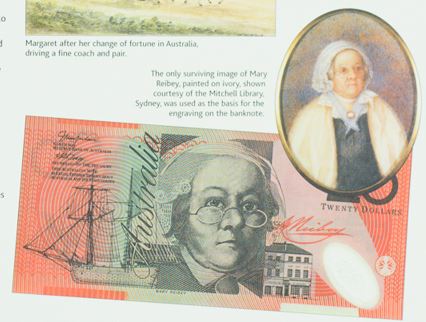
Born in 1777, Molly (later Mary) Haydock, a high-spirited girl engaged in a childish prank was caught, dressed in male attire (as Margaret had been) trying to sell a stolen horse (as Margaret had been). She was sentenced to transportation and arrived in the colony just eight years before Margaret. Two years later she married free settler, Thomas Reibey who prospered from shipping interests on the Hawkesbury River. Mary Reibey may well have had a little shop as a sideline to her husband’s business.
When Richard’s book arrived in Australia its readers became convinced that the well-to-do Mary was none other than the peasant girl Margaret Catchpole. Investigators, on finding that both had been sentenced for horse theft whilst wearing male attire in courts in Bury claimed proof. Mary had been tried in Bury, Lancashire and Margaret in Bury St. Edmunds, Suffolk!
Mary died in 1855 having spent the last ten years of her life trying to clear her name. It was not until a supplement to the Ward and Lock Edition of his book dated 1858 that Richard voiced an apology for circumstances that were not of his making. As a further example of the confusion surrounding these lives it was thought by some that Margaret’s image appeared on the Australian $20 bill. It was of course that of Mary Reibey.
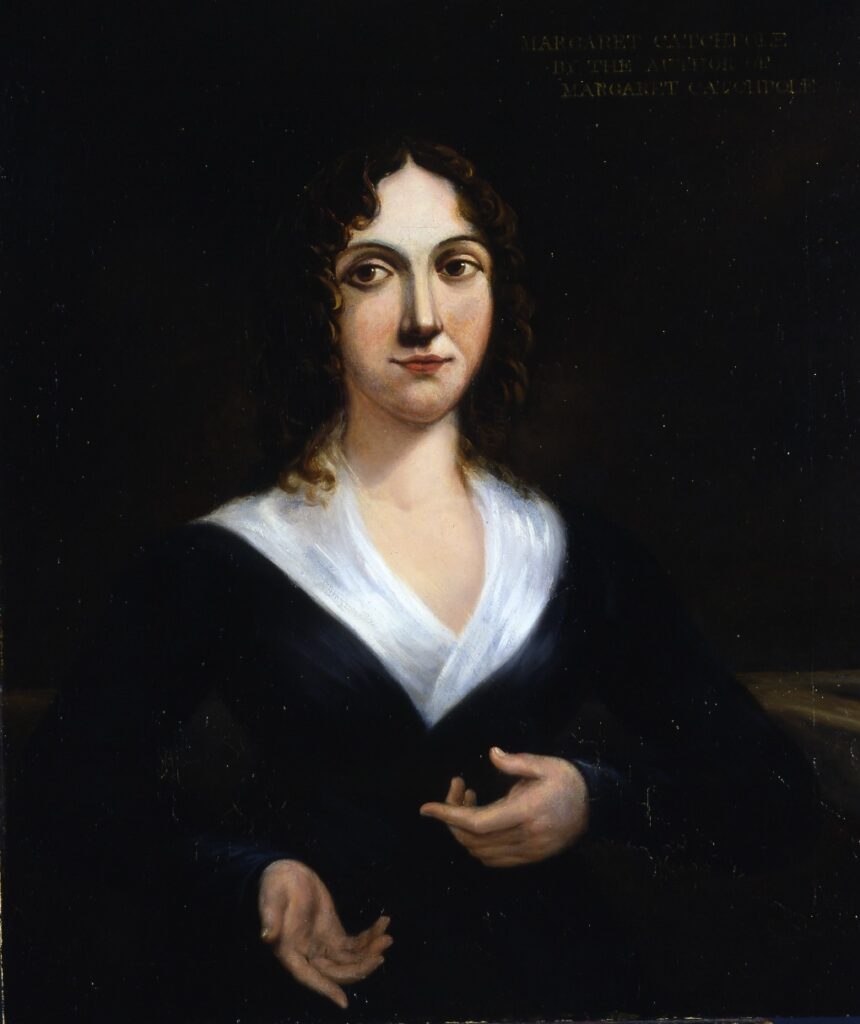
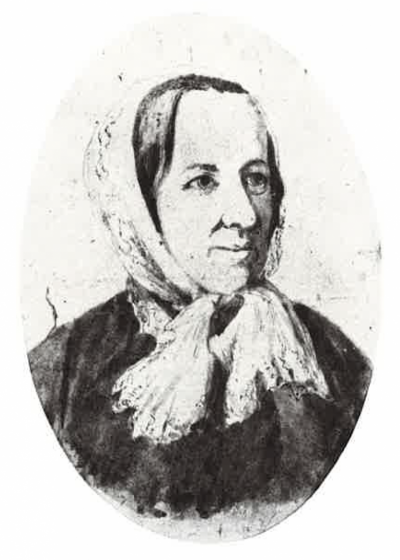
Christchurch Mansion in Ipswich has a portrait of Margaret Catchpole painted by Richard Cobbold which poses a problem. As he was only 4 years old when she left Great Britain the portrait must have been copied, but from what? As far as we know, the ink and wash sketch of Margaret from the Dixon Collection in the State Library in Sydney was never seen by Richard. In our opinion this sketch, although the artist is unknown has the best chance of having been drawn from life.
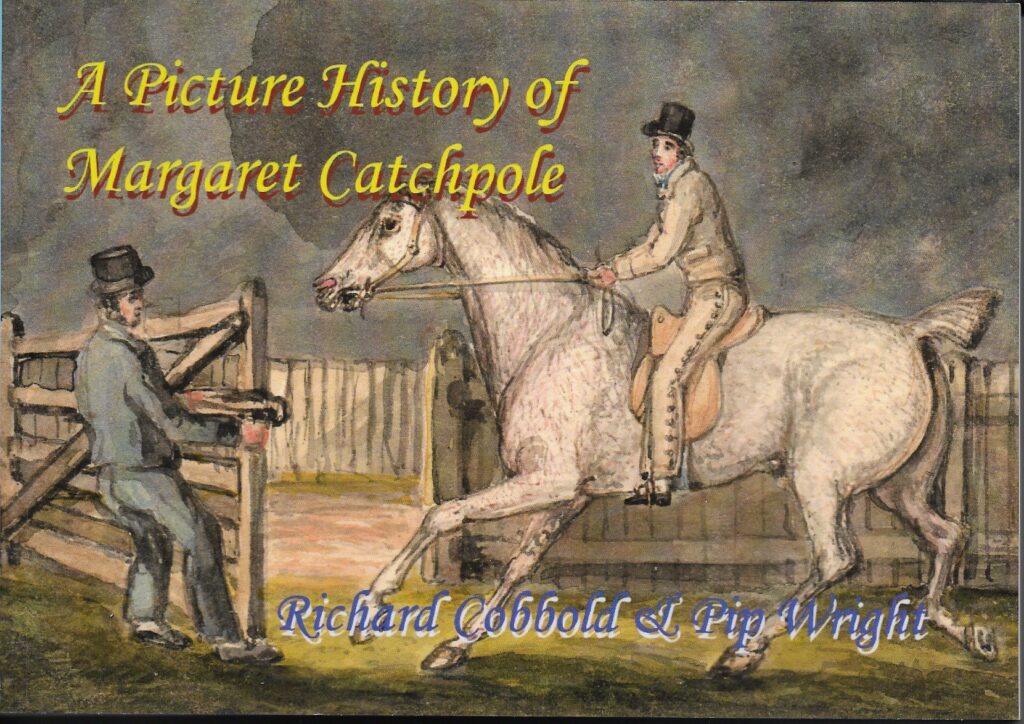
Richard painted thirty-two small watercolours to illustrate his book but for reasons probably of economy only eight of them were ever used and even then, only as black-and-white engravings. The originals were assembled by Richard in a small album in 1874 by which time the disputes were raging so they are interleaved by hand-written comments largely in defence of his story. The Cobbold Family History Trust was fortunate to be able to acquire that album when it came up for sale in 2007.
In 2009, to make them available to a wider public, they were published in A Picture History of Margaret Catchpole, a reduced-text version of the original Richard Cobbold book. The many articles, books, plays, and operettas born of the story are listed by the Australian Dictionary of Biography.

Of all the families for which Margaret worked she was probably closest to the Dights. They lost everything including their home when the Hawkesbury River flooded on 27th March 1806. By chance Margaret was present when the contract was signed for the Dight’s new house on higher ground. She witnessed that contact for the construction of Durham Bowes which stands today, containing Margaret’s accommodation, proudly defiant of developers and boasting a blue plaque indicating its entry on the State Heritage Register. Margaret is buried at St. Peter’s, Richmond close to the Dight plot.